Add
AddAir quality in Gqeberha
Air quality index (AQI⁺) and PM2.5 air pollution in Gqeberha • 8.4K Followers • 16:00, Jun 22 Local time
59
US AQI⁺Moderate

Main pollutant:
PM2.5
13.2 µg/m³

19°

7 km/h

64 %
Hourly forecast
Gqeberha air quality index (AQI⁺) forecast

Daily forecast
Gqeberha air quality index (AQI⁺) forecast
| Today | 58 |  | 24° 12° |  13 km/h | 67% |
| Tue | 54 | | 21° 14° | 19 km/h | 80% |
| Wed | 27 |  | 18° 14° | 15 km/h | 80% |
Air pollutants
What is the current air quality in Gqeberha?

PM2.5 concentration is currently 2.6 times the World Health Organization annual PM2.5 guideline value.
Health recommendations
 Sensitive groups should reduce outdoor exercise |
 Close your windows to avoid dirty outdoor air Get a monitor |
 Sensitive groups should wear a mask outdoors Get a mask |
 Sensitive groups should run an air purifier Get an air purifier |
Protect yourself from air pollution in Gqeberha

Air Purifiers

Face Masks

Air Quality Monitors
Health recommendations
Sensitive groups should reduce outdoor exercise |
Close your windows to avoid dirty outdoor air Get a monitor |
Sensitive groups should wear a mask outdoors Get a mask |
Sensitive groups should run an air purifier Get an air purifier |
Protect yourself from air pollution in Gqeberha
Air Purifiers
Face Masks
Air Quality Monitors
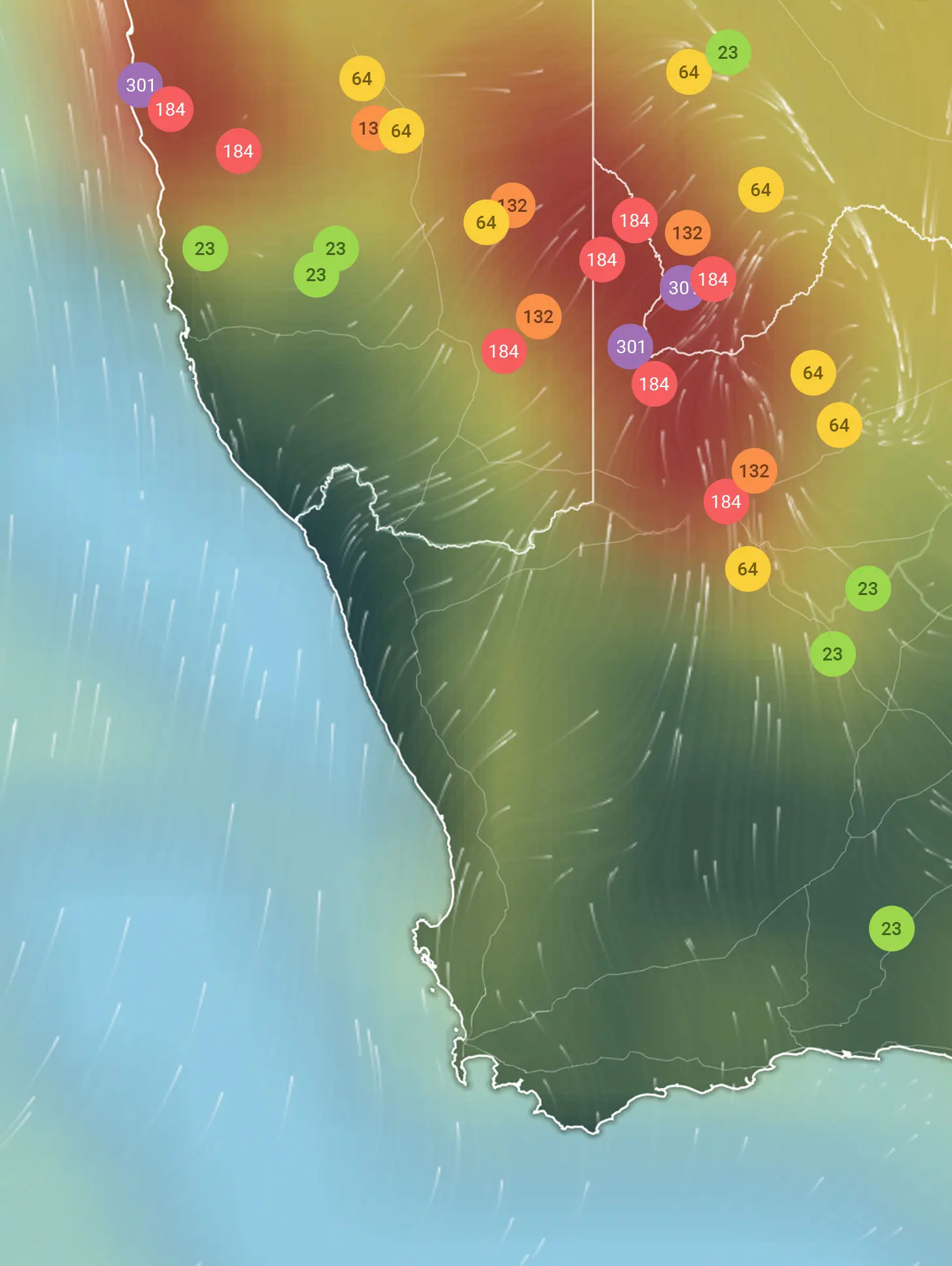
Most polluted locations near Gqeberha
Worldwide AQI⁺ ranking
Station ranking
Real-time AQI⁺ station ranking for stations in Gqeberha

City ranking
Real-time South Africa AQI⁺ city ranking
Historic air quality near Gqeberha
History
Historic air quality graph for Gqeberha
Historic air quality near Gqeberha
History
Historic air quality graph for Gqeberha
Most polluted locations near Gqeberha
Worldwide AQI⁺ rankingStation ranking
Real-time AQI⁺ station ranking for stations in Gqeberha
City ranking
Real-time South Africa AQI⁺ city ranking



Measure your own air quality
Get a monitor and contribute air quality data in your city.
Learn more about global air quality


Learn more about air pollution in Gqeberha
What is the current air quality in Gqeberha?
The current air quality in Gqeberha is considered moderate. Air quality is acceptable for most people, though sensitive individuals may experience mild symptoms such as coughing or shortness of breath.
What is the current level of air pollution in Port Elizabeth?
Port Elizabeth, officially renamed Gqeberha and colloquially often referred to as PE, is a major seaport city in Eastern Cape province in South Africa. The city's name change was officially gazetted on 23rdFebruary 2021. According to a census conducted in 2020, Port Elizabeth had an estimated population of approximately 970,000 people. This increased to 1.15 million when considering the entire metropolis.
Towards the end of 2021, Port Elizabeth was enjoying a period of “Good” quality air with a US AQI reading of 47. This United States Air Quality Index number is calculated using the levels of six of the most commonly occurring air pollutants, such as nitrogen dioxide, sulphur dioxide, ozone, carbon monoxide and both sizes of particulate matter, which are PM2.5 and PM10. It can then be used as the metric when comparing air quality in other cities around the world. If data is unavailable for all 6 pollutants, a figure can still be calculated by using what figures there are. In Port Elizabeth, four pollutants were recorded which were; PM2.5 - 9.2 µg/m³, PM10 - 52 µg/m³, nitrogen dioxide (NO2) - 30.2 µg/m³ and sulphur dioxide (SO2) - 5.2 µg/m³.
This level of PM2.5 is below the recommended safe level of 10 µg/m³ as suggested by the World Health Organisation (WHO) as being an acceptable level. Although no amount of air pollution is considered to be safe.When the air quality is “Good”, doors and windows can be safely opened to allow the clean fresh air inside. All forms of outdoor activity can be enjoyed without fear of contaminated air. For up-to-date information about air quality, there is an app available from AirVisual which is downloadable for all mobile devices.
Does the level of air pollution vary throughout the year in Port Elizabeth?
Air quality is very volatile as it is subject to many external influencing factors such as meteorological and atmospheric changes.
Looking back at the figures for 2020, released by IQAir.com, it can be seen that the months with the best quality air were January until May and August until December. During these ten months, the air quality was below the target figure of 10 µg/m³ as recommended by the World Health Organisation (WHO). The lowest reading which indicates the best quality was during the months of January and again in November with readings of 7.2 µg/m³. The worst month was October with a 9.1 µg/m³ reading. The month of June returned a reading from the “Good” category with an 11.2 µg/m³ figure. July returned “Moderate air with a figure of 13.1 µg/m³.
Records for air pollution were first held in 2019 when a figure of 10.6 µg/m³ was recorded, which was from the “Good” category. Last year was even better when the WHO target figure was achieved with a reading of just 9.0 µg/m³. But this reading may have been affected by the COVID-19 situation as many vehicles were no longer in daily use because the offices were closed, in an attempt to halt the spread of the virus. Many factories and non-essential production units were also required to close which removed their emissions from the atmosphere.
What is the main source of air pollution in Port Elizabeth?
In South Africa, outdoor and indoor air pollution is considered a serious problem and emissions such as sulphur dioxide, particulate matter, nitrogen dioxide, nitric oxide, ozone, benzene and volatile organic compounds are considered a cause for concern. The air quality in different areas of the country is affected by air pollution that ends up in the air from various sources. These sources include power generation activities, industrial processes, waste disposal, transportation (private and public), biomass incineration (incineration of living or dead plant material including grassland, forest, agricultural waste and incineration of biomass for fuel), household fuel, landfill fuel, wastewater treatment and agriculture.
Industries are a major consumer of energy and rely mainly on fossil fuels, especially coal. The industrial / mining sector is also a major consumer of electricity at a national level. The largest industrial consumer of electricity is the mining sector, followed by the iron and steel, and non-ferrous metal industries.
What can be done to improve air quality in Port Elizabeth?
Most sources of air pollution are far beyond the control of individuals and require action by city governments, as well as national and international policymakers in sectors such as transport, energy waste management, buildings and agriculture.
- Conserve electricity where you can. Lower the thermostat of your water heater and switch it off during the day. Turn off lights, computers, and electric appliances when not in use. Do not leave then on stand-by.
- Use energy efficient light bulbs and appliances.
- imit driving by reducing the number of trips you take in your car by carpooling, use public transportation, cycle or walk when possible.
- Keep your car, boat and other engines properly tuned and maintained, and avoid engines that smoke. Follow the manufacturer’s instructions on routine maintenance, such as changing the oil and filters, and checking tyre pressure and wheel alignment. It all helps the engine to be more efficient.
- Use electric or hand-powered lawn care equipment.
- Reduce or eliminate fireplace and wood stove use.
- Avoid burning leaves, garbage and other materials. Instead, make compost from leaves and garden waste.
What are the health impacts of breathing dirty air in Port Elizabeth?
The pollutant which has the most detrimental effects on the body is the microscopic particulate matter or PM2.5 as it is often known. These tiny particles are suspended in the air and breathed into the lungs. Due to their size, the body’s natural defence system cannot trap them so they become lodged in the alveoli at the base of the bronchial tubes. From here they are able to enter the bloodstream and penetrate the body tissue and travel as far as the heart. Respiratory illnesses such as asthma, bronchitis and emphysema are commonly found in polluted areas.
According to the World Health Organisation (WHO), more than 90 per cent of the world population live in places with low air quality. The WHO indicates that air pollution causes 7 million deaths worldwide annually.
Among the diseases caused by air pollution are chronic obstructions, lung cancer, ischemic heart disease and strokes.