Air quality in Queensland
Air quality index (AQI⁺) and PM2.5 air pollution in Queensland • 05:01, Oct 20

Live most polluted city ranking
Real-time Queensland most polluted city ranking

Wildfires in Queensland
Real-time information

Active fires
2


Learn more about global air quality


Learn more about air pollution in Queensland
How bad is the air pollution in Queensland?
Like much of Australia, Queensland state experiences relatively healthy air quality most of the year round in comparison with global locations; however, Queensland air quality is vulnerable to experiencing occasional extreme air pollution episodes, most often in the form of wildfires and dust storms. Australia’s north-eastern most state, Queensland is Australia’s second largest state by land mass, and third largest by population, with a varied landscape including tropical rainforests, coral reefs, mountain ranges and deserts.
The Queensland government monitors air quality around the state, tracking levels of 6 key pollutants: ozone (O3), particulate matter (PM2.5 and PM10), carbon monoxide (CO), lead, nitrogen dioxide (NO2) and sulphur dioxide (SO2). Of these, the main pollutant of concern within Queensland is particulate matter: this is not only because of the significant health impacts PM poses to the general population, but because PM is the pollutant which most often exceeds Australia’s national air quality standards within Queensland.1 Australia has one of the strictest air quality standards in the world for PM2.5, reflecting its relatively clean air quality most of the time, in global comparison. While the World Health Organisation (WHO)’s international PM2.5 guideline is not to exceed a mean concentration of 10 μg/m3 within a year, the Australian standard is a lower 8 μg/m3, which is planned to reduce further to 7 μg/m3 by 2025.2 Conversely, the Australian standard for short term (24-hour) PM2.5 exposure matches the WHO’s 24-hour guideline, both set at a daily limit of 25 μg/m3.
During 2019, while 10 out of 19 Queensland locations included in IQAir’s 2019 World Air Quality Report exceeded Australia’s national PM2.5 standard of 8 μg/m3, almost all locations did achieve the WHO’s standard of 10 μg/m3, with the exception of Woolloongabba air quality.3 Woollongabba, the suburb of Brisbane just south-east of the capital’s CBD and home to several major roads, narrowly missed the WHO target with an annual average of 10.1 μg/m3. Following Woolloongabba, Queensland’s most polluted locations for PM2.5 pollution during 2019 were Manly West air quality (9.5 μg/m3), Cannon Hill (9 μg/m3), and Rocklea (9 μg/m3). Brisbane air quality, the state’s capital, ranked as the state’s 9th most polluted city out of 19, with an annual PM2.5 average of 8.1 μg/m3, which shows a slight increase from its previous years’ measurements (7.2 μg/m3 in 2018, and 6.4 μg/m3 in 2017). This slight increase in 2019 could partly be linked to the extreme bushfires that swept Australia during the “black summer” of 2019-2020, affecting Queensland along with enormous parts of the Australian land and population.
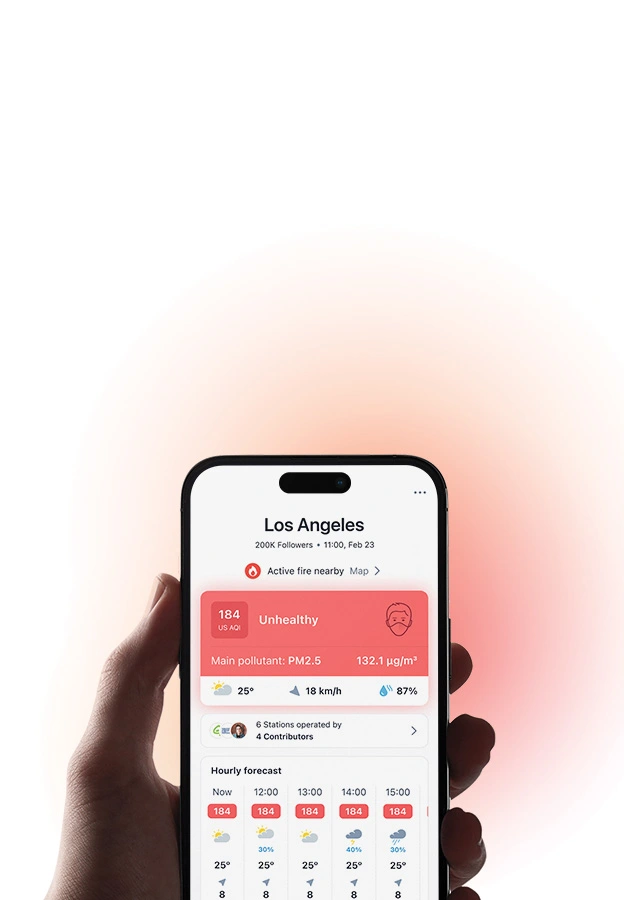
Current air quality information is displayed within the Queensland air quality map at the top of this page, which also contains live wildfire updates. These, along with a 7-day Queensland air quality forecast can also be followed on-the-go with the IQAir AirVisual air pollution app.
What are the health impacts of Queensland air pollution?
Describing particles smaller than 10 microns or 2.5 microns in diameter (abbreviated to PM10 and PM2.5 respectively), particulate matter pollution is particularly hazardous to human health, due to its tiny size enabling it to travel deep into the human system upon inhalation. PM2.5 are the most hazardous particles of all, since their microscopic size enables them to travel into the human lungs, then beyond into the bloodstream, causing a range of health effects, particularly affecting respiratory and cardiovascular health. Certain parts of the Queensland population are most vulnerable to the effects of air pollution, such as children, the elderly, pregnant women, and those with pre-existing health conditions.
Despite Australia’s air pollution remaining at a relatively low level year-round, health experts have emphasised that there is no known “safe” level of air pollution, below which no health impacts may be observed. For example, one Australian study observing the health effects of air pollution in Brisbane, Melbourne, Perth and Sydney in 2005 found that an elevation of 10 μg/m3 of PM2.5 pollution can be associated with a 1% increase in the number of total daily deaths. Meanwhile, a multi-city study looking at the effects of air pollution on health in several Australian and New Zealand cities, including Brisbane, over a 4-year period found that increased levels of air pollutants (including CO, NO2, PM2.5, PM10 and ozone) correlated with increases in mortality from cardiovascular and respiratory disease. These conditions were also associated with increased hospital admissions from a range of diseases, such as ischemic heart disease, myocardial infarction (heart attack), and cardiac failure, with elderly people worst affected.4 Additionally, a further study examining the causes of 240,000 deaths in Queensland found that every increase of 1 microgram per cubic meter (μg/m3) of PM2.5 could be associated with a 2% increase in the risk of death.5
What are the main sources of air pollution in Queensland?
The main sources of particle pollution in Queensland include motor vehicles, industrial activity, and natural events such as wildfires and dust storms. Coal mines have also been shown to generate increased levels of air pollutants such as PM, nitrogen oxides and metals, which affects the health of coal-mining communities, of which there are several in Queensland.6
Is Queensland threatened by fire?
Australia has long experienced annual wildfires during its summer months to some extent, with an established fire season. Queensland state is no exception to being affected by wildfires at various points in the year. Different parts of Australia typically become most prone to bushfires at different times of year in accordance with seasonal weather patterns. In northern Australia, the peak bushfire season is during dry season, usually through winter and spring; whereas southern Australia experiences peak bushfire season during summer and autumn. Given Queensland’s north-eastern position, its northern areas are prone to experience fires during winter and spring, while southern Queensland is most vulnerable during spring to mid-summer.7
During the summer of 2019-2020, Australia experienced particularly devastating wildfires, due to several months of drought, low rainfall and record-breaking temperatures. This applied to Queensland bushfires as well during this season. In coastal areas of south-east Queensland, September is typically the month with highest bushfire danger. In early September 2019, this danger was higher than anything previously recorded at this time of year. Between 6-7 September 2019, catastrophic bushfires had established across the areas of Stanthorpe, Applethorpe, Beechmont, Springbrook, Witheren, Numinbah Valley and Sarabah, with a total of 60 fires burning statewide by 8 September. After this beginning, the wildfires persevered through the fire season, eventually officially ending within Queensland 5 months later on 31 January 2020. The catastrophic summer had involved 35,000 Queensland emergency fire personnel, while the blazes had destroyed approximately 6.6 million hectares of land, 49 houses, 68 sheds, and 5 commercial buildings.8
What are the environmental effects of Queensland air pollution?
Air pollution not only poses hazards to human health, but also to the natural environment. Queensland air pollution can reduce visibility, while ground-level ozone can cause damage to agricultural crops, forests, and reduce the growth rates of plants. Nitrogen oxides and sulphur dioxide cause harm to soils, lakes and rivers by causing them to become more acidic, which can in turn lead to killing animal and plant life. Air pollution in the form of ammonia and nitrogen oxides can also disturb ecosystems both on land and water, by introducing excessive amounts of the nutrient nitrogen, a process also called ‘eutrophication’.9 Several of these environmental impacts are likely to cause economic knock-on impacts too, for example, the economic loss caused by damaged crop yields.
What is Queensland doing about air pollution?
The Queensland Government monitors air quality at a range of monitoring stations around the state, to track pollution trends and measure whether Queensland air quality is achieving Australia’s broader air quality standards. Australia’s national standards, known as the National Environment Protection Measure (Air NEPM), set long- and short-term limits for various pollutants that air pollution should not exceed, based on scientific health guidance. Queensland is responsible to try to ensure that the state’s air quality does not exceed these health-based standards.
The Queensland government also communicates its air quality monitoring data to the public using a Queensland Air Quality Index (AQI). The Queensland AQI follows the broader Australia air quality AQI system, in expressing pollution levels as a proportion of the pollutant’s NEPM limit. For example, an AQI reading of ‘100’ would represent 100% of that pollutant’s maximum permitted amount within the standard, and 200 AQI would represent a twofold exceedance, and so on. The scale is intended to simplify air quality measurements into an easy-to-understand single metric of health hazard, for the public. The Queensland AQI scale is color-coded, increasing from 0-33, “Very good” (green), up to 150+, “Very poor” (deep red).10
Where is the best air quality in Queensland?
The cleanest location for PM2.5 pollution within Queensland during 2019 according to IQAir’s 2019 World Air Quality Report, was the town of Moranbah air quality, with an annual average of 4.1 μg/m3. The next cleanest locations for PM2.5 pollution emerged as the town of Charters Towers (5.9 μg/m3), the city of Mount Isa (6.3 μg/m3), and the city of Townsville (6.5 μg/m3).2
+ Article resources
[1] Queensland Government. “Particulate concentrations”. Queensland Government State of the Environment website, February 12, 2020.
[2] Australian Government. “National air quality standards, Ambient air quality (2016)”. Australia State of the Environment website, 2016.
[3] IQAir. “2019 World Air Quality Report”. IQAir website, March 18, 2020.
[4] Climate and Health Alliance. “Inquiry into the impacts on health of air quality in Australia”. Climate and Health Alliance website, March, 2013.
[5] Stuart Layt. “Brisbane’s ‘safe’ levels of pollution still raise death risk, research finds.” Brisbane Times, July 1, 2020.
[6] Michael Hendryx et al. “Air Pollution Emissions 2008-2018 from Australian Coal Mining: Implications for Public and Occupational Health”. International Journal of Environmental Research and Public Health, 17(5), March, 2020. DOI: 10.3390/ijerph17051570
[7] Australian Government Bureau of Meteorology. “Bushfire weather”. Australian Government Bureau of Meteorology website, n.d.
[8] Australian Institute for Disaster Resilience. “Queensland, September 2019 – December 2019, Bushfires – Black summer”. Australian Disaster Resilience Knowledge Hub, n.d.
[9] Queensland Government. “Air Quality”. Queensland Government State of the Environment website, August 26, 2020.
[10] Queensland government. “Air quality index”. Queensland government website, August 12, 2020.
Which is the most polluted city in Queensland?
- Maryborough48
- The Gap48
- Boyne Island42
- Targinnie39
- Clinton38
- North Ward38
- South Gladstone37
- Mackay36
- West Rockhampton36
- Yarwun34
- Gold Coast33
- Eastern Heights26
- Moranbah26
- Cleveland25
- Mountain Creek25
- North MacLean25
- Townsville25
- Nambour23
- Nerang23
- Oxenford23
- South Brisbane23
- Springwood23
- Woolloongabba23
- Charters Towers22
- Emerald22
- Redlynch22
- Rocklea22
- Blackwater21
- Cannon Hill21
- Gladstone21
- Highvale20
- Westbrook19
- Mount Gravatt East15
- Sunshine Coast13
- Brisbane11
- North Ipswich11
- Cloncurry10
- Mount Isa10
- Bracken Ridge9
- Bridegman Downs9
- Wynnum West9
- Hughenden8
- Wynnum7
- Agnes Water6
- Annerley6
- Ascot6
- Atherton6
- Ayr6
- Bald Hills6
- Balmoral6
- Beenleigh6
- Belmont6
- Biloela6
- Black Mountain6
- Boat Creek6
- Bohle Plains6
- Bongaree6
- Booval6
- Bowen6
- Brassall6
- Brighton6
- Buderim6
- Bundaberg6
- Bundaberg North6
- Bundamba6
- Burbank6
- Burleigh Waters6
- Burpengary6
- Caboolture6
- Caboolture South6
- Cairns6
- Calliope6
- Caloundra6
- Caloundra West6
- Camp Hill6
- Carindale6
- Cedar Vale6
- Chambers Flat6
- Chandler6
- Chermside West6
- Childers6
- Chinchilla6
- Churchill6
- Clear Island Waters6
- Clontarf6
- Collingwood Park6
- Cooktown6
- Coolum Beach6
- Coopers Plains6
- Cooroibah6
- Coorparoo6
- D'Aguilar6
- Dalby6
- Darling Heights6
- Deagon6
- Deception Bay6
- Deebing Heights6
- Dicky Beach6
- East Ipswich6
- East Toowoomba6
- Eight Mile Plains6
- Everton Park6
- Ferny Hills6
- Flinders View6
- Forest Lake6
- Fortitude Valley6
- Gatton6
- Gayndah6
- Goodna6
- Goondiwindi6
- Gordon Park6
- Grange6
- Greenslopes6
- Gympie6
- Hamilton6
- Hervey Bay6
- Home Hill6
- Inala6
- Ingham6
- Innisfail6
- Jacobs Well6
- Kenmore Hills6
- Kingaroy6
- Kirwan6
- Kuranda6
- Little Mountain6
- Logan City6
- Logan Reserve6
- Lower Beechmont6
- Mackenzie6
- Magnetic Island6
- Main Beach6
- Maleny6
- Mango Hill6
- Manly West6
- Mansfield6
- Mareeba6
- Margate6
- Memorial Park6
- Milton6
- Moggill6
- Monkland6
- Mooloolaba6
- Morayfield6
- Morningside6
- Murrumba Downs6
- Mutdapilly6
- Narangba6
- Nathan6
- New Auckland6
- Nobby6
- Noosa Heads6
- Noosaville6
- North Booval6
- Oakey6
- One Mile6
- Ormeau Hills6
- Palm Beach6
- Palm Cove6
- Paradise Point6
- Park Ridge South6
- Peregian Springs6
- Port Douglas6
- Proserpine6
- Pullenvale6
- Raceview6
- Rainbow Beach6
- Rangeville6
- Ravenshoe6
- Red Hill6
- Redbank6
- Redbank Plains6
- Redland Bay6
- Richlands6
- Riverhills6
- Riverview6
- Robertson6
- Rochedale South6
- Rockhampton6
- Roma6
- Sadliers Crossing6
- Samford Valley6
- Sandgate6
- Sarina6
- Scarborough6
- Scarness6
- Seven Hills6
- Seventeen Mile Rocks6
- Sharon6
- Shorncliffe6
- Silkstone6
- Slacks Creek6
- Somerset6
- Southport6
- Spring Hill6
- Springfield6
- Springfield Lakes6
- Stafford6
- Stafford Heights6
- Stanthorpe6
- Strathpine6
- Stuart6
- Sunnybank6
- Sunnybank Hills6
- Surfers Paradise6
- Taigum6
- Tallebudgera6
- Tallebudgera Valley6
- Tamborine Mountain6
- Taringa6
- Taroom6
- Tarragindi6
- Tewantin6
- Thabeban6
- Thagoona6
- Thursday Island6
- Tieri6
- Tin Can Bay6
- Tinbeerwah6
- Tivoli6
- Tolga6
- Toolooa6
- Top Camp6
- Torquay6
- Trinity Beach6
- Tugun6
- Twin Waters6
- Upper Coomera6
- Upper Mount Gravatt6
- Urangan6
- Urraween6
- Varsity Lakes6
- Victoria Point6
- Wacol6
- Walkerston6
- Warwick6
- Waterford West6
- Wavell Heights6
- Weipa6
- Wellington Point6
- Westcourt6
- Wilsonton Heights6
- Wilston6
- Windaroo6
- Windsor6
- Wondai6
- Woodford6
- Woodridge6
- Woody Point6
- Wooloowin6
- Woombye6
- Woorim6
- Woree6
- Yamanto6
- Yandina6
- Yarraman6
- Yatala6
- Yeerongpilly6
- Yeppoon6
- Yeronga6
- Yorkeys Knob6
- Zillmere6
- Mount Nathan0
- Paddington0
- Toowoomba0