Menambahkan
Kualitas udara di Calgary
Indeks kualitas udara (AQI⁺) dan polusi udara PM2.5 di Calgary • 305.5K Pengikut • 20.00, Okt 08 Waktu setempat
33
AQI⁺ USBaik

Polutan utama:
PM2.5
6 µg/m³

11°

8 km/h

52 %
Prakiraan per jam
Prakiraan indeks kualitas udara (AQI⁺) Calgary


Prakiraan setiap hari
Prakiraan indeks kualitas udara (AQI⁺) Calgary
| Hari ini | 10 |  | 16° 7° |  30 km/h | 49% |
| Jum | 8 |  | 1° -2° | 31 km/h | 73% |
| Sab | 8 | | 3° -5° | 16 km/h | 73% |
Polutan udara
Berapa kualitas udara saat ini di dekat Calgary?

Konsentrasi PM2.5 saat ini 1.2 kali nilai panduan PM2.5 tahunan WHO.
Rekomendasi kesehatan
 Enjoy outdoor activities |
 Open your windows to bring clean, fresh air indoors Get a monitor |
lindungi dirimu dari polusi udara di Calgary

Memantau udara yang Anda hirup
Dapatkan pembacaan kualitas udara AirVisual yang akurat dan wawasan waktu nyata untuk udara yang lebih bersih. Monitor yang menunjukkan sumber polusi, menyoroti kapan penggunaan pembersih udara diperlukan.

Pembersih udara kelas medis
Dipercaya di seluruh dunia, HealthPro Series menggunakan teknologi HyperHEPA. Menyaring partikel sangat halus yang tidak dapat disaring oleh pembersih udara lainnya, memberikan perlindungan tingkat medis.

Pembersih udara yang kuat dan penuh gaya
Ringkas dan bertenaga, Seri Atem memadukan rekayasa Swiss dengan pemurnian udara berkinerja tinggi, menyaring partikel sangat halus dengan teknologi HyperHEPA.
Fasilitas Udara Bersih

Serbuk sari
Berapa jumlah serbuk sari di Calgary hari ini?
Indeks

Rendah
 Pohon Tidak ada | 0% |
 Rumput Tidak ada | 0% |
 Gulma Rendah | 25% |
Sumber:
wetter.comRekomendasi kesehatan
Enjoy outdoor activities |
Open your windows to bring clean, fresh air indoors Get a monitor |
Serbuk sari
Berapa jumlah serbuk sari di Calgary hari ini?
Indeks
Rendah
Pohon Tidak ada | 0% |
Rumput Tidak ada | 0% |
Gulma Rendah | 25% |
Sumber:
wetter.comlindungi dirimu dari polusi udara di Calgary
Memantau udara yang Anda hirup
Dapatkan pembacaan kualitas udara AirVisual yang akurat dan wawasan waktu nyata untuk udara yang lebih bersih. Monitor yang menunjukkan sumber polusi, menyoroti kapan penggunaan pembersih udara diperlukan.
Pembersih udara kelas medis
Dipercaya di seluruh dunia, HealthPro Series menggunakan teknologi HyperHEPA. Menyaring partikel sangat halus yang tidak dapat disaring oleh pembersih udara lainnya, memberikan perlindungan tingkat medis.
Pembersih udara yang kuat dan penuh gaya
Ringkas dan bertenaga, Seri Atem memadukan rekayasa Swiss dengan pemurnian udara berkinerja tinggi, menyaring partikel sangat halus dengan teknologi HyperHEPA.
Lokasi paling berpolusi dekat Calgary
Rangking AQI⁺ Seluruh Dunia
Ranking stasiun
Ranking stasiun AQI⁺ real-time untuk stasiun di Calgary

Rangking kota
Ranking kota Canada AQI⁺ waktu nyata
Kualitas udara historis di dekat Calgary
Riwayat
Grafik riwayat kualitas udara untuk Calgary
Kualitas udara historis di dekat Calgary
Riwayat
Grafik riwayat kualitas udara untuk Calgary
Fasilitas Udara Bersih
Lokasi paling berpolusi dekat Calgary
Rangking AQI⁺ Seluruh DuniaRanking stasiun
Ranking stasiun AQI⁺ real-time untuk stasiun di Calgary
Rangking kota
Ranking kota Canada AQI⁺ waktu nyata
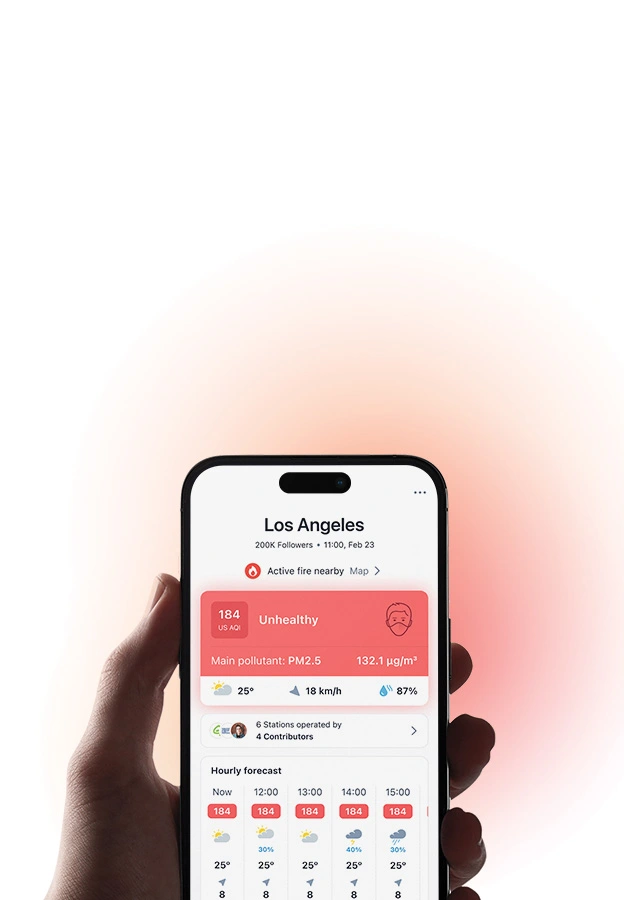


Measure your own air quality
Get a monitor and contribute air quality data in your city.
Pelajari lebih lanjut tentang kualitas udara global


Pelajari lebih lanjut tentang polusi udara di Calgary
Bagaimana kualitas udara saat ini di Calgary?
Kualitas udara saat ini di Calgary dianggap baik. Udara bersih dan menimbulkan sedikit atau tidak ada risiko kesehatan.
Is Calgary a city with a good quality of air?
Calgary is a city located in the southern region of Canada, not far from the northern border of the United States, and is contained within the province of Alberta. It saw a huge amount of development due to being at the center of Canadas oil industry, and is now a well developed city with many skyscrapers and a good urban infrastructure. It has a population of approximately 1.58 million people, making it the most populous city in the province of Alberta, and second out of all cities in the western portion of Canada.
It has a strong economy centered around energy production industries, the finance sector, entertainment, technology and many more, being home to many corporate headquarters and head offices. Whilst these are all great factors for quality of life for its inhabitants, it can occasionally have an effect on the pollution levels, bringing the numbers to less than appreciable levels. Whilst overall it has a very good quality of air in regards to cities worldwide, there are certain months when the pollution levels rise.
In 2019, Calgary came in at 3828th place out of all cities ranked worldwide, with a PM2.5 reading of 6.9 μg/m³, one that placed it into the World Health Organizations (WHO's) target rating for the best quality of air at 10 μg/m³ or less, with the closer to 0 a city achieves of course being the most optimal. This very respectable reading of 6.9 μg/m³ also placed it in 71st place out of all cities ranked in Canada, showing how good the countries overall air quality is, which in itself ranks 90th out of all 98 countries registered worldwide, being one of the countries that sees some of the cleaner air qualities round the globe.
What are some of the main causes of air pollution in Calgary?
Whilst much of the year sees a great level of air quality, there are times when these PM2.5 readings rise considerably, which will be discussed in more detail in following. PM2.5 refers to particulate matter that is 2.5 micrometers or less in diameter, on occasion going down to sizes as small as 0.001 microns across. Due to this extremely small size, it has the potential to cause significant damage to human health, and as such is used as a major component in the calculation of the overall AQI, or air quality index.
Some of the main causes of pollution in Calgary would be emissions from vehicles, ranging from personal ones such as motorbikes and cars, up to industrial or service ones such as trucks, lorries and buses, with these larger ones often releasing higher amounts of fumes and thus being a significant contributor to pollution levels, as well as releasing microscopic traces of rubber on the roads in large quantities. Other causes include ones such as industrial emissions, coming from factories and power plants, as well as the agricultural sector. Construction sites can release numerous contaminating chemicals and fine particulate matter into the air, and lastly, the burning of wood by individual citizens can also skew the air quality readings, leading to higher numbers being shown.
What are some of the main pollutants found in the air in Calgary?
Due to a large amount of sectors and industries contributing to pollution levels in Calgary, there would be a wide variety of chemical contaminants and fine particulate matter permeating the ground level air and upper atmosphere in Calgary. Some of these would be ones that see their release from vehicles, which include black carbon, the main component of soot and a potent carcinogen when inhaled. It also has prominent effects on the environment due to its property of absorbing solar radiation and releasing it as heat, having climate altering effects if left to gather in large enough quantities. Other chemicals released from vehicles include nitrogen dioxide (NO2) and sulfur dioxide (SO2), with nitrogen dioxide always being the most prominent offender when it comes to pollution found over areas of high traffic.
Other noteworthy pollutants in the air would be volatile organic compounds (VOC's) such as benzene, methylene chloride and formaldehyde, of great danger to human health due to their ability to maintain a gaseous state at much colder temperatures, and thus much easier to respire. In closing, others found in the air would be microscopic particles of rubber and plastic, as well as finely ground silica and concrete dust released from construction sites, alongside dioxins, furans and even the occasional toxic metal such as lead or mercury.
When is the air quality at its best in Calgary?
Going off the data gathered over the course of 2019, Calgary saw its best levels of air quality in the months of June through to November, and whilst the whole year itself came in with respectable readings within the WHO's target goal (aside from one month that came in significantly higher, which was May with a reading of 14.4 μg/m³), there were periods where the PM2.5 levels dropped even lower, albeit without as strong a pattern as some other cities that see distinct summer and winter seasons occurring.
The cleanest months of the year were April (somewhat anomalous due to being sandwiched between two much more polluted months), June, September and November, all with PM2.5 readings of 4.9 μg/m³, 4.9 μg/m³, 4.4 μg/m³ and 4.9 μg/m³ respectively, with the number 4.9 μg/m³ making multiple appearances. This indicates that September was the cleanest month of the entire year during 2019 with its reading of 4.4 μg/m³.
Is the air quality improving in Calgary?
Looking at the data taken in the years prior to 2019, we can observe that there was a difference in the yearly averages available. 2017 came in with a PM2.5 average of 7.5 μg/m³, a respectable reading by any means that was still within the WHO's target goal. This was followed in 2018 with a yearly average of 10.9 μg/m³, one that represented a significant jump that was enough to earn itself a place in the ‘good’ ratings bracket, which requires a PM2.5 reading of anywhere between 10 to 12 μg/m³ for classification. So, in hindsight, with 2019’s reading of 6.9 μg/m³ being available, it is clear that the air quality has improved over the last two years, a great indicator that any initiatives in place to clean up the air are indeed working, and may see further improvements over the following years.
Di manakah kualitas udara paling bersih di Calgary?
- West Bragg Creek10
- Elbow Valley21
- Everstone, Calgary21
- Tuscany Calgary, AB21
- Northwest Calgary 222
- 5705 23 Ave SE23
- Montgomery, Calgary24
- Southeast Calgary24
- Upper Mount Royal24
- 302 - 200 Patina Court SW26
- 3815 16 St SW27
- Evanscrest Pl NW28
- Silverview DR Silver Springs28
- Edgemont29
- 72 Ave NE31
- 2144 Paliswood Rd32
- 250-196 Citadel Estates Heights NW32
- Northwest Calgary32
- 26-54 Macewan Park View NW33
- Bonavista GRN33
- Heritage Isle33
- Kensington33
- Ranchlands33
- Ranchridge Court Calgary33
- Stranraer33
- Wildwood36
- Hawkwood39
- Mahogany39
- 1527 Lake Twintree Way SE41
- Altadore 44 Ave SW44
- Coach Hill44
- Cranston Ridge 244
- Patterson Bay SW44
- Springbank44
- Cranston50
- Calgary Central251
- Calgary Northwest51
- Calgary Varsity51
- 100 Gordon Dr SW52
- Edgevalley Circle52
- Auburn Bay53
- Citadel53
- Homestead53
- McKenzie Lake53
- Calgary Central Inglewood55
- West Hillhurst55
- Evergreen Hill SW56
- Walden56
- CALGARY SOUTHEAST57
- Silverado Ranches60
- Calgary North Glenmore68