Añadir
Calidad del aire en Long Beach
Índice de calidad del aire (ICA⁺) y contaminación del aire PM2.5 en Long Beach • 49.7K Seguidores • 04:00, jun 19 Hora local

24
ICA⁺ USBueno

Contam. principal:
PM2.5
4.5 µg/m³

17°

7 km/h

83 %
Pronóstico horario
Pronóstico del índice de calidad del aire (AQI⁺) de Long Beach


Pronóstico diario
Pronóstico del índice de calidad del aire (AQI⁺) de Long Beach
| Hoy | 35 |  | 22° 17° |  16 km/h | 71% |
| sáb | 46 | | 23° 15° | 15 km/h | 72% |
| dom | 30 |  | 21° 17° | 19 km/h | 63% |
Contaminantes del aire
¿Cuál es la calidad de aire actual en Long Beach?

La concentración de PM2,5 actualmente cumple con la directriz anual de PM2,5 de la OMS.
Recomendaciones de salud
 Enjoy outdoor activities |
 Open your windows to bring clean, fresh air indoors Get a monitor |
Protégete de la contaminación del aire en Long Beach

Controle el aire que respira
Obtenga lecturas precisas de la calidad del aire de AirVisual e información en tiempo real para un aire más limpio. Monitores que revelan las fuentes de contaminación y señalan cuándo es necesario utilizar un purificador de aire.

Purificadores de aire de calidad médica
La HealthPro Series, de confianza en todo el mundo, utiliza la tecnología HyperHEPA. Filtra partículas ultrafinas que otros purificadores de aire pasan por alto, ofreciendo una protección de grado médico.

Potentes y elegantes purificadores de aire
Compacta y potente, la serie Atem combina la ingeniería suiza con la purificación de aire de alto rendimiento, filtrando partículas ultrafinas con la tecnología HyperHEPA.
Instalaciones con aire limpio
Polen
¿Qué concentración de polen hay hoy en Long Beach?
Índice

Bajo
 Árboles Bajo | 25% |
 Gramíneas Bajo | 25% |
 Maleza Ninguno | 0% |
Fuente:
wetter.comRecomendaciones de salud
Enjoy outdoor activities |
Open your windows to bring clean, fresh air indoors Get a monitor |
Polen
¿Qué concentración de polen hay hoy en Long Beach?
Índice
Bajo
Árboles Bajo | 25% |
Gramíneas Bajo | 25% |
Maleza Ninguno | 0% |
Fuente:
wetter.comProtégete de la contaminación del aire en Long Beach
Controle el aire que respira
Obtenga lecturas precisas de la calidad del aire de AirVisual e información en tiempo real para un aire más limpio. Monitores que revelan las fuentes de contaminación y señalan cuándo es necesario utilizar un purificador de aire.
Purificadores de aire de calidad médica
La HealthPro Series, de confianza en todo el mundo, utiliza la tecnología HyperHEPA. Filtra partículas ultrafinas que otros purificadores de aire pasan por alto, ofreciendo una protección de grado médico.
Potentes y elegantes purificadores de aire
Compacta y potente, la serie Atem combina la ingeniería suiza con la purificación de aire de alto rendimiento, filtrando partículas ultrafinas con la tecnología HyperHEPA.
Lugares más contaminados cerca de Long Beach
Ranking AQI⁺ mundial
Ranking de estaciones
Ranking AQI⁺ de estaciones en tiempo real en Long Beach

Ranking de ciudades
Ranking de calidad del aire AQI⁺ de USA en tiempo real
Calidad del aire histórica cerca de Long Beach
Historial
Gráfico de calidad del aire histórica para Long Beach
Calidad del aire histórica cerca de Long Beach
Historial
Gráfico de calidad del aire histórica para Long Beach
Instalaciones con aire limpio
Lugares más contaminados cerca de Long Beach
Ranking AQI⁺ mundialRanking de estaciones
Ranking AQI⁺ de estaciones en tiempo real en Long Beach
Ranking de ciudades
Ranking de calidad del aire AQI⁺ de USA en tiempo real
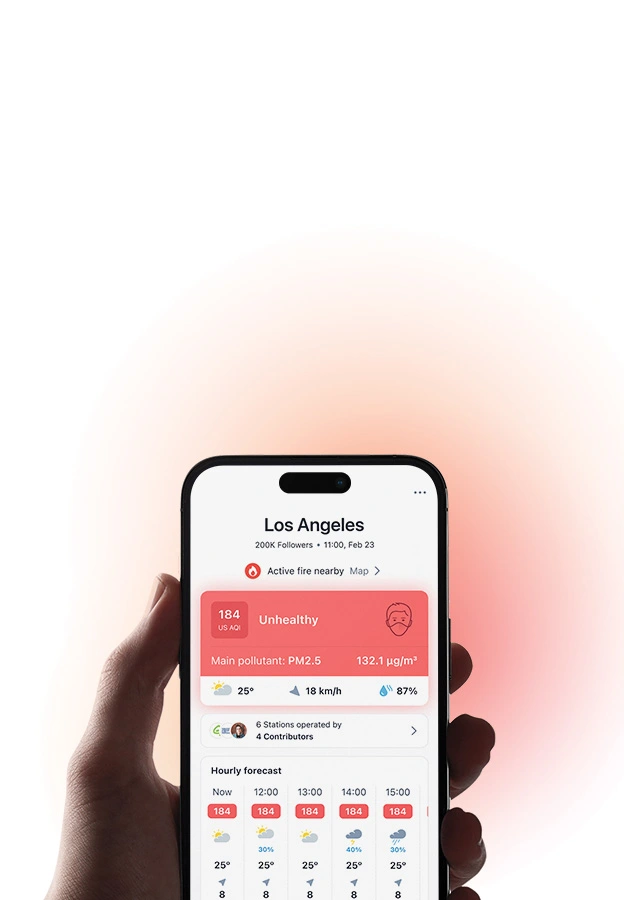


Measure your own air quality
Get a monitor and contribute air quality data in your city.
Obtén más información sobre la calidad del aire global


Obtén más información sobre la contaminación del aire en Long Beach
¿Cuál es la calidad del aire actual en Long Beach?
La calidad del aire actual en Long Beach se considera buena. El aire es limpio y representa poco o ningún riesgo para la salud.
How bad is the air pollution in Long Beach?
Long Beach is a city found in the state of California, within the metropolitan area of Los Angeles. With a population of over 463 thousand people, it is counted as the 43rd most populous city in the country, as well as the seventh most populous within the state itself. As a coastal city facing onto the North Pacific Ocean, Long Beach grew substantially as a seaside resort town, as well as having a prominent presence revolving around the oil industry, and possessing one of the busiest seaport's within the country. This seaport is also counted as one of the largest in the world, and still plays a substantial role in the economy of Long Beach till today, as well as having an impact on the quality of the air.
Regarding the pollution levels taking place within the city, Long Beach was recorded as having a PM2.5 reading of 15.1 μg/m³ in 2019, a fairly high reading that placed it into the ‘moderate’ pollution rating bracket, which requires a PM2.5 reading of anywhere between 12.1 to 35.4 μg/m³ to be classified as such. This indicates that the city of Long Beach is subject to some less than perfect levels of air quality, and could do much to improve its condition, with many months of the year rising to even higher levels that have far reaching consequences on the health of its citizens.
This reading of 15.1 μg/m³ placed the city in 1365th place out of all cities ranked worldwide, a considerably high ranking for U.S city. It also came in at 167th place out of all cities ranked in America, and as mentioned, could go a long way to improve its air pollution levels.
What causes polluted air in Long Beach?
Long Beach has several main causes of air pollution, with some of them being more long term and ‘ambient’ in nature, meaning that they are responsible for raised pollution readings throughout the year, whilst others are more acute in nature and are responsible for sudden spikes in the AQI, or air quality index. One of the main ones that sees the year round readings rise by considerable amounts is that of vehicular pollution. With a sizeable population coupled with many people commuting in and out of the city, there would be a large amount of subsequent exhaust fumes being released, with tens of thousands of cars and motorbikes on the road at any given time.
Furthermore, in regards to the movement of industrial items as well as food products, for both import and export, heavier duty vehicles are often required. These include ones such as trucks and lorries, and due to their great size and weight as well as running on diesel fuels, are also responsible for putting out even larger amounts of smoke and pollution, more so than a singular vehicle of a smaller size.
Regarding the large port site present in the city, a huge amount of pollution is also released from this area, with numerous ships docking at the port and releasing their own pollutants, as well as thousands of tons of cargo being transported from the ships to warehouses requiring excessive use of the aforementioned heavy duty vehicles. Other main sources include ones such as emissions from factories, power plants and other industrial areas, as well as construction sites and road repairs.
Who is most at risk from air pollution in Long Beach?
Whilst pollution has far reaching effects that can cause numerous adverse health conditions amongst all members of the population, it remains that there are certain groups that are considerably more at risk to air pollution, for a number of reasons usually pertaining to age, health and physical background.
Some members of these groups include people such as the elderly, young children, pregnant mothers, those with a sensitive disposition towards chemical exposure, as well as those with compromised immune systems or pre-existing health conditions, typically of the cardiac or pulmonary variety. Pregnant mothers find themselves in great danger of excessive pollution exposure, with instances of miscarriage, premature birth or babies born with a low birth weight all being possible. Children can also develop health issues or allergies that can subsequently turn into lifelong issues if not suitable addressed at an early stage.
When is the air quality at its worst in Long Beach?
Observing the data taken over the course of 2020, there were many months of the year that showed elevated levels of PM2.5 in the air throughout Long Beach. In terms of time frame, it appears that the latter portion of the year is when the air quality was at its worst. June came in with a fairly respectable reading of 9 μg/m³, which was then followed by a jump up to 11.9 μg/m³ in July, and then an even further leap to 13.6 μg/m³ in August.
This reading of 11.9 μg/m³ put July into the ‘good’ air quality ratings bracket, and August in the ‘moderate’ air pollution bracket with its reading of 13.6 μg/m³. This continued for the rest of the year, with highs of 24.8 μg/m³ and 24.5 μg/m³ being reached in September and October, making them the most polluted months of the year (with September taking the top spot), as well as the surrounding months also displaying higher levels of PM2.5 in the air.
What are some of the main types of pollution found in Long Beach?
In reference to the main causes of pollution found occurring within Long Beach, there would be a large amount of related pollutants found in the air, with certain ones being far more prevalent. Ones that would be seen in larger quantities, typically emanating from vehicle and ship exhausts (as well as other combustion sites) would be ones such as nitrogen dioxide (NO2) and sulfur dioxide (SO2).
Both are contributors to acid rain, and can cause inflammation of the respiratory tract as well as damage to the lung tissue. Nitrogen dioxide is released in large quantities from vehicle engines, whilst sulfur dioxide can be found more prevalently in fumes released from ships, due to the larger amounts of sulfur often found in ship fuels due to differences in fuel regulations.
Other prominent pollutants include ones such as ozone (O3), which can be formed when the various oxides of nitrogen (NOx) are exposed to solar radiation via sunlight (both found in abundance in Long Beach), which then convert to ozone, or smog as it is known when it accumulates in large enough amounts.
It is a vital component of the upper atmosphere, but a highly damaging pollutant when found at ground level. Other pollutants also include black carbon, fine silica and gravel particles, as well as volatile organic compounds (VOC's), some examples of which include chemicals such as benzene, formaldehyde, methylene chloride and xylene.
¿Cuál es la cantidad del aire más limpia de Long Beach?
- Conservation Corps of Long Beach - Deforest11
- AirFalcon12
- Attica Drive14
- Canton17
- Alamitos Beach21
- Chestnut Ave21
- Bixby Knolls22
- Conservation Corps of Long Beach - Nieto22
- Little Owl School22
- Studebaker22
- CCA Carson & Long Beach23
- Upper Westside23
- 4011-3947 Linden Ave24
- CCA 61st and Walnut24
- West Melrose Way25
- Brayton Ave27
- Termino Ave28
- 98-2 S 14th Pl29
- CCA 4th and Los Altos29
- Chatwin Avenue32
- Craftsman Village32
- 644-672 Termino Ave33
- 399-341 E Maple Way34
- 133 Long Beach Blvd36
- Poinsettia & Cherry37
- Los Altos39