Air quality in Pune
Air quality index (AQI⁺) and PM2.5 air pollution in Pune • 215.8K Followers • 03:30, Dec 26 Local time
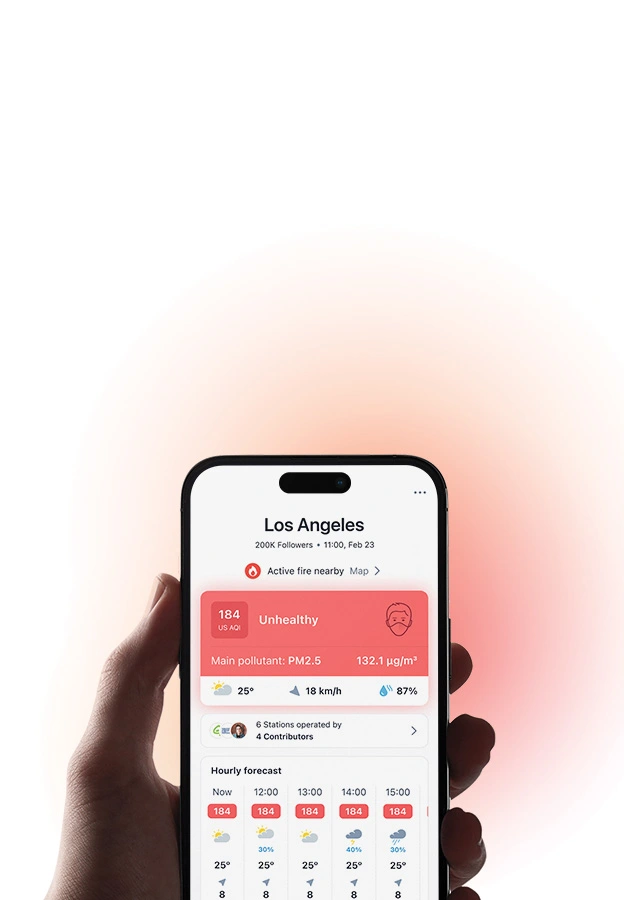
196
US AQI⁺Unhealthy
Main pollutant:
PM2.5
120.2 µg/m³
18°
3.4 km/h
41 %
Hourly forecast
Pune air quality index (AQI⁺) forecast
Daily forecast
Pune air quality index (AQI⁺) forecast
| Today | 192 | 27° 13° | 14.4 km/h | 30% | |
| Sat | 100 | 27° 16° | 10.8 km/h | 27% | |
| Sun | 111 | 28° 15° | 10.8 km/h | 33% |
Air pollutants
What is the current air quality in Pune?
PM2.5 concentration is currently 24 times the World Health Organization annual PM2.5 guideline value.
Health recommendations
Avoid outdoor exercise |
Close your windows to avoid dirty outdoor air Get a monitor |
Wear a mask outdoors Get a mask |
Run an air purifier Get an air purifier |
Protect yourself from air pollution in Pune
Shop IQAir productsHealth recommendations
Avoid outdoor exercise |
Close your windows to avoid dirty outdoor air Get a monitor |
Wear a mask outdoors Get a mask |
Run an air purifier Get an air purifier |
Protect yourself from air pollution in Pune
Shop IQAir productsMost polluted locations near Pune
Worldwide AQI⁺ rankingStation ranking
Real-time India AQI⁺ station ranking
Historic air quality near Pune
History
Historic air quality graph for Pune
Learn more about air pollution in Pune
Historic air quality near Pune
History
Historic air quality graph for Pune
Clean Air Facilities
Learn more about air pollution in Pune
Most polluted locations near Pune
Worldwide AQI⁺ rankingStation ranking
Real-time India AQI⁺ station ranking
Measure your own air quality
Get a monitor and contribute air quality data in your city.
Is Pune a polluted city?
According to the available figure on the reputable IQAir.com website, Pune experiences “moderate” air quality for approximately 7 months of the year. Three months put it into the “Unhealthy for sensitive groups” category and the remaining two months push it into the “Unhealthy “level. These levels are the recommended figures provided by the World Health Organisation (WHO). The winter months of December and January were the worst months whilst July proved to be the cleanest.
What is the air quality index in Pune?
In 2019 Pune ranked as the 299th dirtiest city in the world with an average pm”.5 reading of 35.7 µg/m³. This figure is considerably better than the average figure for 2018 which was 46.3 µg/m³ and also a slight improvement on the 2017 figure of 37 µg/m³. This data is gathered from three monitoring stations in different parts of the city. One of which is operated by the Central Pollution Control Board.
What is being done about air pollution in Pune?
According to the environment department, levels of air pollution are beginning to stabilize due to a raft of measures by the local government. The main one being the strict new regulations concerning vehicle emissions. Newer vehicles use up-to-date technology and therefore produce less harmful emissions.
Other measures taken include the prohibition of the burning of garbage within the city and the building of more footpaths and cycle track which help reduce dust emissions. More than 50 per cent of the cities’ buses are now powered by electricity. Other publicly owned and operated vehicles are encouraged to use compressed natural gas or CNG.
As it is mainly vehicles which are the main cause of pollution, a fall in the number of new registrations can be for the good. A report conducted in August 2019 concluded that for the period 2018-19, 261.000 vehicles were registered as opposed to 289,000 registered in the 2017-18 period. These vehicles were the two-wheeled motorbikes and the three-wheeled auto-rickshaws.
The report includes data collected from many reputable sources such as the ground-based government-operated monitoring stations and other verified stations operated by organizations and some private individuals.
The festival of lights or Diwali as it is known is celebrated every year by Hindus, Sikhs and Jains. It can last up to five days and takes place during the lunisolar month of Kartika or Mid-October to mid-November. During this festivity, candles, lanterns and oil burners and used extensively in all participating homes and fireworks and firecrackers are set-off. The latter producing a considerable amount of pollution. The government has asked, this year that fireworks are avoided so as to reduce pollution.
Civil society stakeholders are working together to find a way to improve the air quality in Pune. The Indian government launched the National Clean Air Programme (NCAP) in 2019 to address this problem. It is their intention to reduce air pollution by 20-30 per cent by 2024 in 122 cities, throughout India. The chosen cities are the ones that regularly record levels of pollution that are in excess of the guidelines.
The expansion of electric vehicles, both private and the public is being encouraged, as is an enhanced system of regulations and monitoring of the industrial sector is also part of the plan.
What are the harmful effects of breathing Pune’s polluted air?
The report mainly focuses on the microscopic particulate matter PM2.5 which, because of their size have the ability to bypass the bodies’ self-defense mechanism and are inhaled directly into the lungs. They eventually find their way into the alveoli which ate the tiny air sacs located at the base of the bronchial tubes. From here they can enter the bloodstream before eventually reaching the heart. This has far-reaching detrimental implications by inducing asthma, aggravating heart disease and even contribute to lung cancer.
Pune is in the state of Maharashtra and has approximately 7 million inhabitants and is continuing to grow rapidly. Poor air quality has always been a challenge and in particular, the finer particles called PM2.5 because of their microscopic size. The levels of these particles is constantly higher than the recommended levels suggested by both the local government and the World Health Organization (WHO).
Drawing on the evidence base, the issue draws attention to the considerable burden of air pollution on public health in the city and in terms of thousands of respiratory illnesses and premature deaths linked to polluted air each year. The damage caused to public health is growing annually so urgent measures need to be taken as soon as possible to improve the situation.
In October 2019 there was a huge spike recorded in certain areas of Pune. Blue Ridge in Hinjewadi and parts of Wakad faced particularly high levels of pollution. Many of the residents of those areas faced serious health problems such as itchy skin, watering eyes and irritated airways. Doctors from that part of the city reported an increase of 30 – 40 per cent in upper respiratory tract infection (URTI).
Many residents were investing in air purifiers for their homes as they became increasingly concerned about the future of their health.
Is Pune more polluted than Mumbai?
Mumbai is among the 6 most polluted cities in India. The other five being Pune, Delhi, Ahmedabad, Kolkata and Chennai. Because of the lockdown created due to the COVID 19 pandemic, officials were able to establish baseline pollution levels. They took the opportunity of that and the fact that the weather was forecast to be very calm over the next few days to establish a baseline from which to work in the future. A minimum figure was recorded and found to remain constant for a period of 2.3 days. The levels of pollutants were measured between 20th February and 14th April which represents pre-lockdown and lockdown figures. The records revealed that in Mumbai the PM2.5 measurement was 33 µg/m³, while Chennai recorded a figure of 6 µg/m³ which was undoubtedly the lowest and well with the WHO recommended limits. Ahmedabad recorded 32 µg/m³, Pune 29 µg/m³, Delhi 22 µg/m³ and Kolkata was 18 µg/m³.