Añadir
Calidad del aire en Yokohama
Índice de calidad del aire (ICA⁺) y contaminación del aire PM2.5 en Yokohama • 42.7K Seguidores • 03:00, oct 24 Hora local
56
ICA⁺ USModerado

Contam. principal:
PM2.5
12 µg/m³

20°

5 km/h

77 %
Pronóstico horario
Pronóstico del índice de calidad del aire (AQI⁺) de Yokohama

Pronóstico diario
Pronóstico del índice de calidad del aire (AQI⁺) de Yokohama
| Hoy | 57 |  | 20° 17° |  23 km/h | 65% |
| dom | 57 |  90% | 20° 18° | 33 km/h | 83% |
| lun | 54 | | 23° 21° | 32 km/h | 81% |
Contaminantes del aire
¿Cuál es la calidad de aire actual en Yokohama?

La concentración de PM2,5 es actualmente 2.4 veces superior al valor de referencia anual de PM2,5 de la OMS.
Recomendaciones de salud
 Sensitive groups should reduce outdoor exercise |
 Close your windows to avoid dirty outdoor air Get a monitor |
 Sensitive groups should wear a mask outdoors Get a mask |
 Sensitive groups should run an air purifier Get an air purifier |
Protégete de la contaminación del aire en Yokohama

Controle el aire que respira
Obtenga lecturas precisas de la calidad del aire de AirVisual e información en tiempo real para un aire más limpio. Monitores que revelan las fuentes de contaminación y señalan cuándo es necesario utilizar un purificador de aire.

Purificadores de aire de calidad médica
La HealthPro Series, de confianza en todo el mundo, utiliza la tecnología HyperHEPA. Filtra partículas ultrafinas que otros purificadores de aire pasan por alto, ofreciendo una protección de grado médico.

Potentes y elegantes purificadores de aire
Compacta y potente, la serie Atem combina la ingeniería suiza con la purificación de aire de alto rendimiento, filtrando partículas ultrafinas con la tecnología HyperHEPA.
Polen
¿Qué concentración de polen hay hoy en Yokohama?
Índice

Bajo
 Árboles Ninguno | 0% |
 Gramíneas Bajo | 25% |
 Maleza Ninguno | 0% |
Fuente:
wetter.comRecomendaciones de salud
Sensitive groups should reduce outdoor exercise |
Close your windows to avoid dirty outdoor air Get a monitor |
Sensitive groups should wear a mask outdoors Get a mask |
Sensitive groups should run an air purifier Get an air purifier |
Polen
¿Qué concentración de polen hay hoy en Yokohama?
Índice
Bajo
Árboles Ninguno | 0% |
Gramíneas Bajo | 25% |
Maleza Ninguno | 0% |
Fuente:
wetter.comProtégete de la contaminación del aire en Yokohama
Controle el aire que respira
Obtenga lecturas precisas de la calidad del aire de AirVisual e información en tiempo real para un aire más limpio. Monitores que revelan las fuentes de contaminación y señalan cuándo es necesario utilizar un purificador de aire.
Purificadores de aire de calidad médica
La HealthPro Series, de confianza en todo el mundo, utiliza la tecnología HyperHEPA. Filtra partículas ultrafinas que otros purificadores de aire pasan por alto, ofreciendo una protección de grado médico.
Potentes y elegantes purificadores de aire
Compacta y potente, la serie Atem combina la ingeniería suiza con la purificación de aire de alto rendimiento, filtrando partículas ultrafinas con la tecnología HyperHEPA.
Lugares más contaminados cerca de Yokohama
Ranking AQI⁺ mundial
Ranking de estaciones
Ranking AQI⁺ de estaciones en tiempo real en Yokohama

Calidad del aire histórica cerca de Yokohama
Historial
Gráfico de calidad del aire histórica para Yokohama
Calidad del aire histórica cerca de Yokohama
Historial
Gráfico de calidad del aire histórica para Yokohama
Lugares más contaminados cerca de Yokohama
Ranking AQI⁺ mundialRanking de estaciones
Ranking AQI⁺ de estaciones en tiempo real en Yokohama
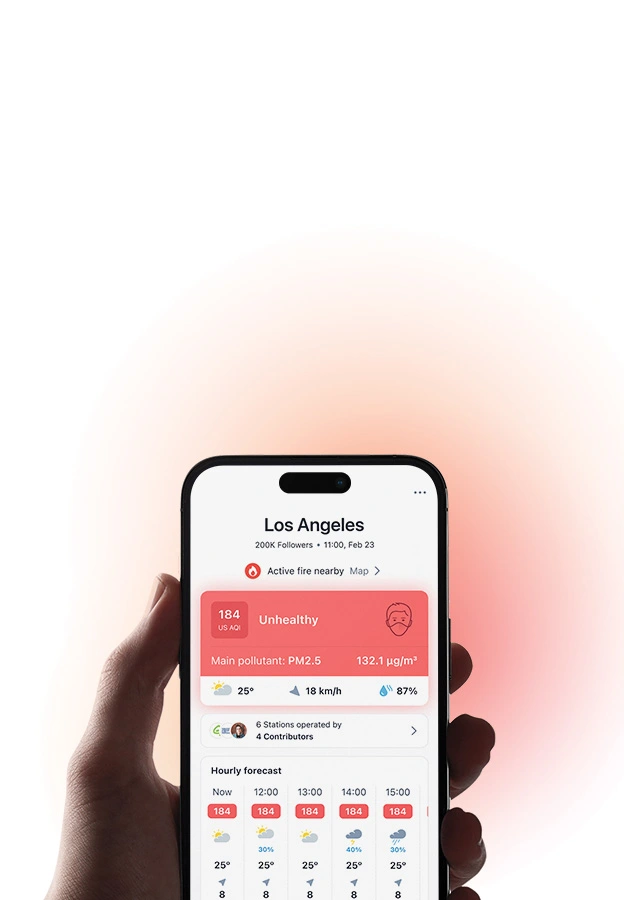


Measure your own air quality
Get a monitor and contribute air quality data in your city.
Obtén más información sobre la calidad del aire global


Obtén más información sobre la contaminación del aire en Yokohama
¿Cuál es la calidad del aire actual en Yokohama?
La calidad del aire actual en Yokohama se considera moderada. Es aceptable para la mayoría de las personas, aunque algunas extremadamente sensibles pueden experimentar leves molestias.
Is Yokohama a city with bad air quality?
Yokohama is a city located in the Kanto region of Japan, just south of Tokyo. It is the second most populous city in the whole country, with some 3.7 million inhabitants living there. It is considered an important commercial hub in the area known as greater Tokyo, with rapid development having taken place during in the last century due to its relevance as a prominent port city.
Looking at its levels of pollution, Yokohama is a city with a respectable level of air quality, although not without some pollutive issues, particularly during certain months of the year. In 2019 it came in with a PM2.5 reading of 10.5 μg/m³, placing it in the lower end of the ‘good’ ratings bracket, which requires a PM2.5 reading of anywhere between 10 to 12 μg/m³ to be classified as such.
This gave it a very fine margin of entry to achieve such a rating, as well as also indicating that Yokohama was only 0.5 units away from moving down into the most optimal group category of 10 μg/m³ or less, which is the World Health Organizations (WHO) target for the best possible quality of air, with readings that verge on the side closer to 0 being the most optimal.
Yokohama’s reading of 10.5 μg/m³ placed it into 2402nd place out of all cities registered around the world, as well as coming in at 362nd place out of all cities in Japan. Hence, it is a city that is privy to good qualities of air for most of the year, with certain months having a few pollutive issues of concern.
What are causes of pollution in Yokohama?
With its close proximity to Tokyo, as well as having a large population coupled with a high amount of industry, subsequently Yokohama would have pollution issues related to these activities, with a high volume of anthropogenic (human related) activities taking place that cause the elevations in PM2.5 as seen in certain months of the year, which will be discussed in further detail.
PM2.5 refers to particulate matter that is 2.5 micrometers or less in diameter, making them approximately 3% the size of a human hair, and sometimes far smaller, going down to sizes as small as 0.001 microns or less. As such PM2.5 is a major component used in the calculation of overall air quality, due to its severe health consequences when found in high quantities in the air.
The main causes of pollution in Yokohama would be vehicle emissions, with many cars and other personal vehicles such as motorbikes doing their daily commute in the city as well as over to Tokyo, along with heavy duty vehicles such as trucks, lorries and buses all releasing their own higher quantities of pollution, often running on fossil fuels such as diesel. Other pertinent sources of pollution would be emissions from factories, with many still running on coal, which along with the combustion of diesel, adds large amounts of chemical pollutants as well as fine particulate matter into the air.
When is Yokohama’s air quality most polluted?
Observing the data taken over 2019, the months that came in with the worst readings of pollution were in the middle portion of the year, with one prominent spike of PM2.5 being recorded in the earlier months but being somewhat of an abnormality.
Yokohama lacks any distinct massive jumps in pollution levels, as is sometimes seen in some of the more polluted cities across Asia, instead tending towards extended periods of mildly raised air pollution levels. May through to September could be seen as being the ‘most polluted’ period of the year, although every month still fell into the good ratings category, never jumping above 12 μg/m³. Despite these mild times of pollution, they fell outside of the WHO's target goal of 10 μg/m³ or less, and thus can be counted as more polluted, relatively speaking.
The month that came in with the worst overall reading of PM2.5 was in February, with a number of 13.6 μg/m³ being recorded, making it the only month of the year to fall into the ‘moderate’ ratings bracket. This bracket requires a PM2.5 reading of anywhere between 12.1 to 35.4 μg/m³ to be classed as such, and represents a change from where the air quality starts to move up to levels where it may be detrimental to certain demographics of the population.
When is Yokohama’s air at its cleanest?
In contrast to the previous question, the months that came in with the cleanest air quality readings were fairly sporadic, not following any particular pattern as is sometimes the case in cities across Asia, due to seasonal factors or related activities denoting heightened pollution, such as the forest and farmland fires in Indonesia affecting pollution levels in Malaysia, South Thailand and Singapore.
Looking at the data, the months that came in with the cleanest readings of PM2.5 were January, April, October and November, all of which fell within the WHO's target goal of 10 μg/m³ or less. Their readings in order were 8.9 μg/m³, 9.7 μg/m³, 8.6 μg/m³ and 8.7 μg/m³ respectively. This showed that October was the cleanest month by a small margin, with all the aforementioned months coming in with the most optimal qualities of air.
What are the main pollutants found in the air in Yokohama?
With much of its pollution emanating from sources such as car, lorry and truck fumes, as well as from industrial areas of factories, alongside any industrial effluence being released into the air from whatever item or material is being produced at these factories (for example, factories involved in the production or recycling of plastic items often will inevitably release burnt plastic fumes into the air).
The main pollutants coming from cars would be nitrogen dioxide (NO2) and sulfur dioxide (SO2), with nitrogen dioxide being the most prominent in its release from vehicles, with known side effects being breathlessness in those who are exposed, as well as damage or rapid aging to the lung tissues over longer periods of time, as well as the triggering of respiratory diseases such as asthma, pneumonia or bronchitis.
Other pollutants would be released from factory areas, particularly those running on coal or other fossil fuels, giving off fine particulate matter such as black carbon, as well as volatile organic compounds (VOC's) and polycyclic aromatic hydrocarbons. Some examples of VOC's would include benzene, formaldehyde and xylene. All are hazardous to human health and very easy to respire, but the most prominent pollutants would be the ones coming from vehicular sources, such as the aforementioned nitrogen and sulfur dioxides.
¿Cuál es la cantidad del aire más limpia de Yokohama?
- Tsurumi-ku Ushioda Exchange Plaza22
- Minami-ku Yokohama Commercial High School28
- Isogo City General Government Building33
- Ushiodacho33
- Asahi-ku Tsurugamine Elementary School39
- Kanagawa City General Government Building39
- Konan Ward Noba Junior High School44
- Nishi-ku Asama Shita-intersection50
- Izumi City General Government Building53
- Kohoku City General Government Building53
- Nagahama, Kanazawa53
- Naka-ku Honmoku53
- Aoba City General Government Building55
- Honmokucho55
- Nishi-ku Hiranuma Elementary School55
- Totsuka-ku Yazawa intersection55
- Kamiyabecho-RUN56
- Midori-ku Miho Elementary School56
- Minami Seya Elementary School56
- Hodogaya-ku Sakuragaoka High School58
- Tsuzuki City General Government Building58
- Aobadai60