Pollen count and allergy info for Newark
Newark pollen and allergy report • 12:00, Oct 9 Local time
Index

Low

Tree
None

Grass
None

Weed
Low
 21°
21° 15 km/h
 40%
40%Daily allergy forecast
Newark pollen count forecast
Today  21 km/h22°12° 53% | Saturday 12 km/h 18°13° 62% | Sunday 22 km/h 90% 90%17°12° 87% |
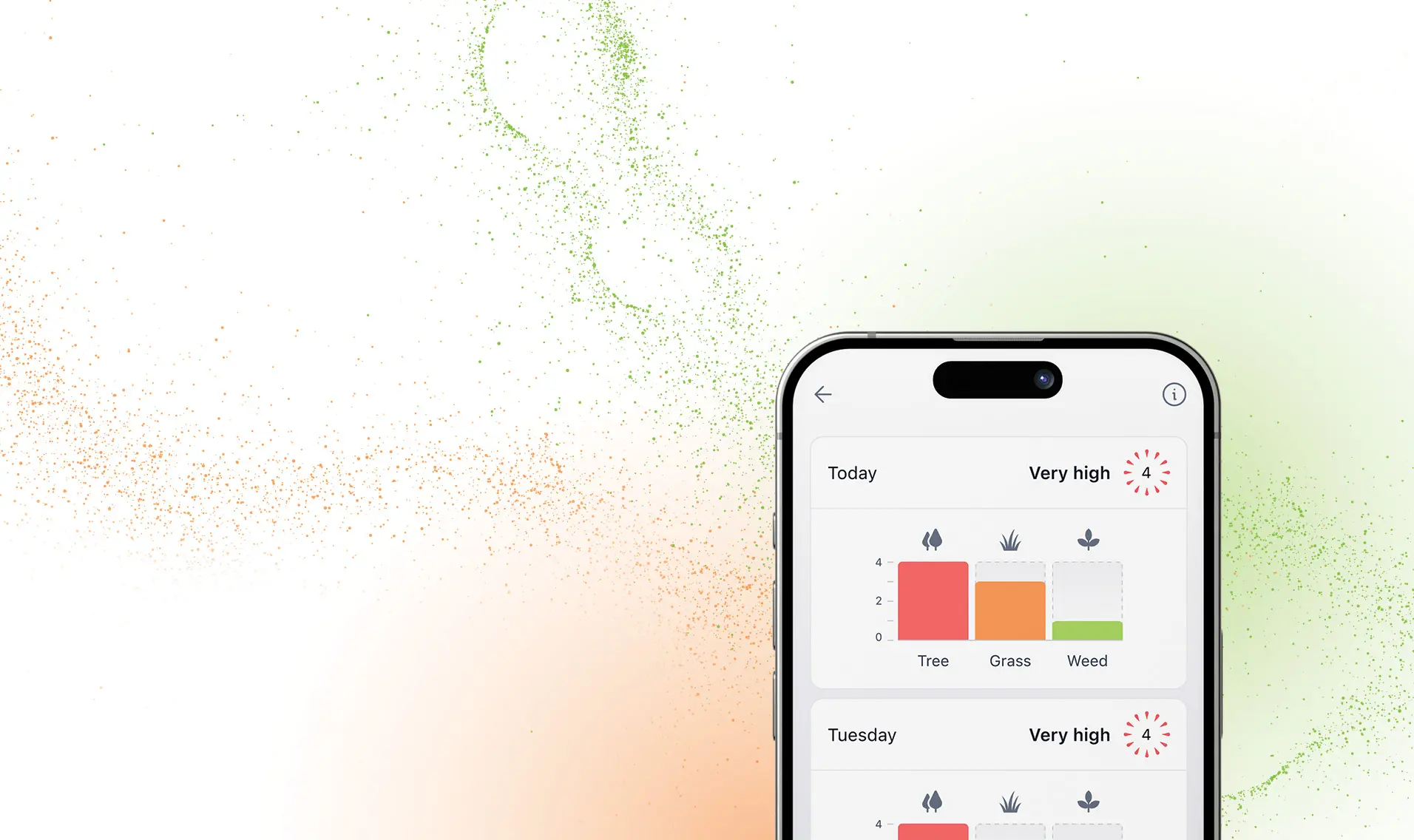

Learn more about pollen in Newark


Protect yourself from air pollution in Newark

Monitor the air you breathe
Get accurate AirVisual air quality readings and real-time insights for cleaner air. Monitors that reveal pollution sources, highlight when air purifier use is needed.

Medical grade air purifiers
Trusted worldwide, the HealthPro Series uses HyperHEPA technology. Filters ultrafine particles other air purifiers miss, delivering medical-grade protection.

Powerful, stylish air purifiers
Compact and powerful, the Atem Series combines Swiss engineering with high-performance air purification, filtering ultrafine particles with HyperHEPA technology.
Download our Air Quality App


How does the pollen count in Newark compare between different times of the day, such as morning, afternoon and evening?
Pollen counts in Newark demonstrate distinct patterns throughout a 24-hour period, influenced by various biological and environmental factors.
Morning (Dawn to Mid-Morning): During the early hours of the day, from dawn until mid-morning, the environment proves conducive for many plants to release their pollen. This activity is rooted in the plants' natural reproductive processes. They release pollen when the air is relatively cooler, and the calm conditions make sure that pollen doesn't get dispersed far and wide immediately. Consequently, this leads to a spike in pollen concentration in the immediate vicinity, resulting in higher pollen levels.
Afternoon (Mid-Morning to Late Afternoon): As the day progresses and the sun climbs higher, the temperature increases, and environmental conditions start to change. The warmth and increased sunlight result in an upward draft, causing lighter airborne particles, including pollen, to be lifted higher into the atmosphere. This natural phenomenon means that pollen concentration at ground level starts to decline during these hours. For residents of Newark, this time might provide some relief from the high pollen counts experienced in the morning, especially if they are outdoors.
Evening (Late Afternoon to Night): With the onset of evening, the environmental factors reverse. The temperature begins to drop, and the upward drafts weaken. Pollen that had been lifted into the atmosphere during the day now begins its descent back to ground level. As a result, there is a noticeable increase in pollen concentration. This rise in pollen levels persists through the evening until night-time. This means that the atmosphere during this period might be as saturated with pollen as it is during the early morning hours.
For the population with heightened sensitivity to pollen, understanding these patterns is crucial. Recognising the peak pollen release times - primarily during early morning and late evening - equips them with the knowledge to make informed decisions about when to venture outside or when to keep windows closed. By doing so, they can reduce exposure to pollen and, in turn, the discomfort it might cause.
Knowledge of these patterns isn't just beneficial for those with pollen sensitivities. It provides valuable insights for all residents, allowing them to better navigate their day and make decisions, such as when to hang laundry outside or when to undertake outdoor activities.
What are the seasonal differences for the pollen count in Newark?
Newark, like many other regions, experiences a dynamic range of pollen types and concentrations depending on the time of year. The change in pollen count is directly linked to the life cycle and reproductive patterns of the various plants found in the area.
Spring: During the spring months, tree pollen dominates the atmosphere in Newark. Trees such as oaks release significant quantities of pollen as they enter their reproductive phase. Maples, another common tree in the region, also contribute to the rising pollen counts, with their distinctively shaped pollen grains becoming airborne and spreading across the area. Pines, with their long cones and needle-shaped leaves, play a role too. These trees, as part of their natural cycle, release pollen to fertilise other trees of the same species, ensuring the continuation of their lineage.
Summer: As the last remnants of spring tree pollen start to wane, the focus shifts to grasses. These grasses, now in their reproductive period, release pollen, leading to a different profile of allergens in the air. Bermuda grass, a common type in Newark and surrounding areas, starts its pollen release, causing discomfort to many residents. Kentucky bluegrass, a favourite for many lawns and parks in the region, also starts contributing its share of pollen. Ryegrass, a tall-growing grass, disperses pollen which can travel long distances in the wind, affecting even those who might not have direct contact with the plant.
Autumn: The arrival of autumn brings with it a decline in grass pollens but sees a surge in weed pollens. Ragweed, in particular, is known for the high volume of pollen it releases, and it can be a primary culprit for late-year allergies in Newark. Sagebrush, with its grey-green leaves, begins to release its lighter, airborne pollen, influencing the overall count. Nettles, often overlooked, also play a part during this season. They release a fine, almost invisible pollen that can easily be carried by even the gentlest of breezes.
Winter: As temperatures drop and days become shorter, plant activity reduces considerably. Winter is marked by the least amount of pollen in the air. Most trees, grasses, and weeds enter a dormant state, conserving energy for the next growth cycle. The lack of active pollen release is reflected in the significantly lower pollen counts during this season. However, it's essential to note that while pollen counts are at their lowest, they never truly reach zero. A few plants might still release pollen, albeit in very minimal quantities.
By understanding the seasonal variations in pollen counts and the types of plants active during each season, residents of Newark can better prepare and manage any pollen-related discomfort or health concerns.
Can the pollen count in Newark vary between different neighbourhoods or regions within the city?
Pollen count differences within Newark are a reality that residents often notice. One of the significant determinants of this variation is the type of vegetation present in specific areas. Each plant species produces its distinct type of pollen, and the concentration of these species varies from one part of the city to another. For example, regions with a higher concentration of oak trees will have more oak pollen compared to areas dominated by grass or other vegetation.
Proximity to larger green spaces, like parks or natural reserves, is another factor to consider. These areas are often hubs of biodiversity, hosting a variety of plant species, each releasing its pollen. Such a concentration of flora results in a higher pollen count, especially during peak flowering seasons. Neighbourhoods adjacent to or surrounded by these green spaces are therefore likely to experience a noticeable uptick in pollen levels during specific times of the year.
On the contrary, urbanised sectors of Newark, where concrete structures dominate and greenery is sparse, usually record lower pollen counts. The limited number of plants means less pollen is produced. However, it's worth noting that these areas aren't entirely free from pollen. Pollen grains are lightweight and can be carried by wind over significant distances. So, even if you're in a highly urbanised part of Newark, you're not entirely isolated from the effects of pollen, especially on days with strong winds.
Local gardening habits within neighbourhoods also play a role. Some residents might favour plants that are prolific pollen producers in their gardens. If many gardens in a particular area have such plants, the collective pollen count can be higher than in places where residents opt for plants that produce less pollen or are pollinated by insects rather than the wind.
For those keen on understanding the pollen dynamics in their locality, several tools and platforms offer insights. Local pollen forecast tools, often available online, provide up-to-date information about pollen levels in different parts of Newark. These tools consider various factors, including current plant blooming stages, recent weather patterns, and historical data, to predict pollen concentrations. Relying on such resources can help residents make informed decisions, especially if they or their loved ones suffer from pollen allergies.
Knowing the factors influencing pollen distribution in Newark helps in understanding its uneven spread. But while each area has its unique pollen profile, the city as a whole remains interconnected. Pollen knows no boundaries, and its movement and effects are a testament to nature's intricate web of relationships.
Does the pollen count in Newark impact the overall air quality index?
The air quality index (AQI) is a tool used to measure the daily concentration of atmospheric pollutants. It considers multiple factors and pollutants in its calculations. Pollen is not directly integrated into AQI calculations. However, the relationship between pollen and other pollutants is important to understand.
Pollen, as microscopic particles, is released by plants during their reproductive phases. When pollen is in the air, especially in high concentrations, it can cause discomfort, even to those who don't typically suffer from allergies. High pollen counts can trigger or exacerbate respiratory conditions. This might lead individuals to perceive the air quality as poor, even if the AQI does not reflect a high pollutant level.
The AQI primarily focuses on pollutants like ozone, particulate matter, nitrogen dioxide, sulphur dioxide, and carbon monoxide. These pollutants can have a range of health effects, varying from minor irritations to severe respiratory and cardiovascular issues. Pollen does not factor directly into this index. However, the presence of pollen in the air can amplify the effects of these pollutants on the respiratory system. For example, when the air has high levels of both ozone and pollen, a person might experience more intense respiratory symptoms than if only one of these factors was present.
Furthermore, in certain situations, pollen can interact with other pollutants. For instance, when pollen particles come into contact with pollutants, it might lead to a transformation of the particles. This can create a more complex mixture of airborne particles that can be inhaled. This interaction is a subject of ongoing research.
One more point to consider is the source of pollen. Different plants release pollen at various times of the year. This means that pollen levels can fluctuate based on the season. While this seasonal fluctuation is predictable to some extent, it's worth noting that environmental changes, such as those brought about by urban development or climate change, can alter the traditional patterns of pollen release.
It's important for individuals, especially those with respiratory conditions or allergies, to be aware of both the AQI and pollen counts. While the AQI provides a measure of certain pollutants, the pollen count provides information about potential allergens in the air. By considering both, people can make informed decisions about outdoor activities and manage their health risks more effectively.
Does the pollen count in Newark impact outdoor activities?
Pollen counts, particularly when high, have a significant effect on outdoor activities in Newark. This effect is evident in the response of individuals with pollen allergies. Pollen is a fine powder released by plants as part of their reproductive cycle. When inhaled, it can trigger an immune response in sensitive individuals. This immune response is what leads to allergy symptoms.
Many residents and visitors to Newark enjoy a range of outdoor activities, from jogging and cycling to attending outdoor festivals and picnics. But a high pollen count can act as a barrier to these activities for a notable segment of the population. The most common symptoms triggered by pollen exposure are sneezing, itchy eyes, and congestion. These symptoms can reduce one's enjoyment of the outdoors and, in severe cases, can even make it difficult for individuals to be outside at all.
For instance, imagine an individual who enjoys morning jogs. During high pollen seasons, the morning can be one of the peak times for pollen release, especially from trees. This individual, if sensitive to pollen, would find it difficult to maintain their routine without experiencing discomfort. The sneezing and congestion can be particularly challenging for those involved in aerobic exercises as it can affect breathing.
Furthermore, itchy eyes, another symptom of pollen allergies, can be a deterrent for those who engage in activities that require sharp vision, such as cycling or ball sports. In such cases, it becomes crucial for participants to be aware of the pollen count and make informed decisions about their plans.
Local pollen forecasts become an essential tool in this context. These forecasts, available on many weather websites and dedicated allergy platforms, provide information about expected pollen levels. They can also offer insights into which specific pollens (tree, grass, or weed) are most prevalent at any given time. By consulting these forecasts, individuals can decide the best times to engage in their favourite outdoor activities. They might opt to adjust their schedule, for instance, postponing an outdoor event to a day with a lower expected pollen count.
Of course, for those with extreme sensitivities, the situation might require more significant adjustments. They might need to stay indoors during certain times of the day or during particular seasons. This is especially true during spring and early summer in Newark when tree and grass pollens are at their peak. Activities such as gardening might also need to be limited or modified, perhaps by choosing plants that are less allergenic.
In essence, while Newark offers a wealth of outdoor opportunities, the pollen count is a critical factor that residents and visitors need to consider. Being informed and making necessary adjustments can help ensure that everyone can enjoy what the city has to offer, regardless of their sensitivity to pollen.
Where is the highest pollen level in New Jersey?
- Allendale2
- Allentown2
- Alpha2
- Alpine2
- Ashland2
- Atco2
- Atlantic2
- Audubon2
- Audubon Park2
- Avenel2
- Barclay2
- Barnegat2
- Barrington2
- Bayonne2
- Beach Haven2
- Beckett2
- Bedminster2
- Bellmawr2
- Belvidere2
- Bergen County2
- Berlin2
- Beverly2
- Blackwells Mills2
- Blackwood2
- Bordentown2
- Bradley Gardens2
- Bridgeton2
- Brooklawn2
- Browns Mills2
- Brownville2
- Buena2
- Burlington2
- Burlington County2
- Camden2
- Camden County2
- Carneys Point2
- Carteret2
- Cedar Glen Lakes2
- Cherry Hill Mall2
- Chesilhurst2
- Clayton2
- Clementon2
- Cliffside Park2
- Cliffwood Beach2
- Closter2
- Collings Lakes2
- Collingswood2
- Colonia2
- Country Lake Estates2
- Crestwood Village2
- Dayton2
- Demarest2
- East Franklin2
- East Millstone2
- Echelon2
- Edgewater2
- Ellisburg2
- Elmer2
- Elwood2
- Emerson2
- Englewood Cliffs2
- Estell Manor2
- Fairton2
- Flemington2
- Florence2
- Florham Park2
- Folsom2
- Fords2
- Forked River2
- Fort Dix2
- Franklin Center2
- Franklin Lakes2
- Franklin Park2
- Franklinville2
- Frenchtown2
- Gibbsboro2
- Gibbstown2
- Gillette2
- Glassboro2
- Glen Rock2
- Glendora2
- Gloucester2
- Gloucester City2
- Golden Triangle2
- Greentree2
- Guttenberg2
- Haddon Heights2
- Haddonfield2
- Hammonton2
- Harrington Park2
- Haworth2
- Hawthorne2
- Heathcote2
- Helmetta2
- Highland Park2
- Hillsdale2
- Ho-Ho-Kus2
- Hoboken2
- Hopelawn2
- Hudson County2
- Iselin2
- Jersey City2
- Jobstown2
- Juliustown2
- Keasbey2
- Kendall Park2
- Keyport2
- Kingston2
- Kingston Estates2
- Laurel Springs2
- Laurence Harbor2
- Lawnside2
- Lebanon2
- Leisuretowne2
- Linden2
- Lindenwold2
- Little Ferry2
- Madison2
- Madison Park2
- Magnolia2
- Manville2
- Margate City2
- Marlboro2
- Matawan2
- McGuire AFB2
- Medford Lakes2
- Metuchen2
- Middlebush2
- Middlesex County2
- Midland Park2
- Milford2
- Millington2
- Milltown2
- Monmouth Junction2
- Morganville2
- Mount Ephraim2
- Mullica Hill2
- Mystic Island2
- National Park2
- New Brunswick2
- New Egypt2
- New Vernon2
- North Haledon2
- Northfield2
- Northvale2
- Norwood2
- Oak Valley2
- Oakland2
- Oaklyn2
- Ocean Acres2
- Old Bridge2
- Old Tappan2
- Olivet2
- Oradell2
- Palisades Park2
- Park Ridge2
- Paulsboro2
- Peapack and Gladstone2
- Pemberton2
- Pemberton Heights2
- Pennington2
- Penns Grove2
- Perth Amboy2
- Phillipsburg2
- Pine Hill2
- Pitman2
- Plainsboro Center2
- Port Reading2
- Presidential Lakes Estates2
- Princeton Junction2
- Princeton Meadows2
- Rahway2
- Ramblewood2
- Richwood2
- Ridgefield2
- Ridgewood2
- Ringwood2
- Robbinsville Center2
- Rockleigh2
- Roebling2
- Rosenhayn2
- Runnemede2
- Rutgers University-Busch Campus2
- Rutgers University-Livingston Campus2
- Saddle River2
- Sayreville2
- Seabrook Farms2
- Sewaren2
- Sicklerville2
- Six Mile Run2
- Somerdale2
- Somerset2
- South Amboy2
- South River2
- Spotswood2
- Springdale2
- Stratford2
- Strathmore2
- Swedesboro2
- Ten Mile Run2
- The College of New Jersey2
- Thorofare2
- Titusville2
- Trenton2
- Tuckerton2
- Turnersville2
- Union Beach2
- Union City2
- Upper Pohatcong2
- Ventnor City2
- Vincentown2
- Vineland2
- Voorhees2
- Waldwick2
- Waretown2
- Wenonah2
- West New York2
- Westmont2
- Weston2
- Westville2
- Westwood2
- Whippany2
- White House Station2
- Williamstown2
- Woodbridge2
- Woodbury2
- Woodbury Heights2
- Woodcliff Lake2
- Woodlynne2
- Alloway1
- Annandale1
- Beattystown1
- Belford1
- Bergenfield1
- Bernardsville1
- Bloomingdale1
- Bogota1
- Boonton1
- Bound Brook1
- Brass Castle1
- Bridgewater Center1
- Brookdale1
- Brookside1
- Budd Lake1
- Butler1
- Byram Center1
- Caldwell1
- Califon1
- Cape May1
- Carlstadt1
- Chatham1
- Chester1
- Clearbrook1
- Clifton1
- Clinton1
- Columbia1
- Concordia1
- Connecticut Farms1
- Cranbury1
- Crandon Lakes1
- Cranford1
- Cresskill1
- Dover1
- Dover Beaches North1
- Dover Beaches South1
- Dumont1
- Dunellen1
- East Freehold1
- East Newark1
- East Orange1
- East Rutherford1
- Eatontown1
- Elizabeth1
- Elmwood Park1
- Englewood1
- Englishtown1
- Essex County1
- Essex Fells1
- Fair Lawn1
- Fairview, Monmouth County1
- Fanwood1
- Far Hills1
- Farmingdale1
- Finderne1
- Fort Lee1
- Franklin1
- Freehold1
- Garfield1
- Garwood1
- Glen Gardner1
- Glen Ridge1
- Great Notch1
- Green Knoll1
- Groveville1
- Hackettstown1
- Haledon1
- Hamburg1
- Hamilton Square1
- Hampton1
- Harrison1
- Hasbrouck Heights1
- High Bridge1
- Highland Lakes1
- Hightstown1
- Holiday City South1
- Hopatcong1
- Hopewell1
- Hunterdon1
- Jamesburg1
- Kean University1
- Keansburg1
- Kearny1
- Kenilworth1
- Kenvil1
- Kinnelon1
- Lake Mohawk1
- Lake Telemark1
- Lakewood1
- Lambertville1
- Lavallette1
- Leisure Village1
- Leisure Village East1
- Leonardo1
- Leonia1
- Lincoln Park1
- Lincroft1
- Little Silver1
- Llewellyn Park1
- Lodi1
- Long Branch1
- Long Valley1
- Marlton1
- Martinsville1
- Maywood1
- Mendham1
- Mercer County1
- Mercerville1
- Merchantville1
- Middlesex1
- Monmouth1
- Monmouth Beach1
- Montclair State University1
- Montvale1
- Moonachie1
- Moorestown-Lenola1
- Morris1
- Morris Plains1
- Morristown1
- Mount Arlington1
- Mountain Lakes1
- Mountainside1
- Netcong1
- New Milford1
- New Providence1
- Newark1
- Newfield1
- Newfoundland1
- Newton1
- North Arlington1
- North Caldwell1
- North Cape May1
- North Middletown1
- North Plainfield1
- Oakhurst1
- Oceanport1
- Ogdensburg1
- Oxford1
- Packanack Lake1
- Palmyra1
- Paramus1
- Parsippany1
- Passaic1
- Paterson1
- Pennsville1
- Pine Brook1
- Plainfield1
- Pleasantdale1
- Pompton Lakes1
- Port Monmouth1
- Preakness1
- Princeton1
- Prospect Park1
- Ramapo College of New Jersey1
- Ramsey1
- Ramtown1
- Raritan1
- Red Bank1
- Ridgefield Park1
- River Edge1
- Riverdale1
- Riverton1
- Robertsville1
- Rockaway1
- Roseland1
- Roselle1
- Roselle Park1
- Rossmoor1
- Rutherford1
- Salem1
- Secaucus1
- Short Hills1
- Shrewsbury1
- Silver Lake, Essex County1
- Silver Ridge1
- Singac1
- Somerset County1
- Somerville1
- South Bound Brook1
- South Plainfield1
- Springfield1
- Stanhope1
- Succasunna1
- Summit1
- Sussex1
- Sussex County1
- Tenafly1
- Teterboro1
- Tinton Falls1
- Toms River1
- Totowa1
- Twin Rivers1
- Union1
- Union County1
- Upper Montclair1
- Upper Saddle River1
- Vauxhall1
- Vernon Center1
- Vernon Valley1
- Victory Gardens1
- Victory Lakes1
- Vista Center1
- Wallington1
- Wanaque1
- Warren1
- Washington1
- Watchung1
- Watsessing1
- West Cape May1
- West Freehold1
- West Long Branch1
- Westfield1
- Wharton1
- White Horse1
- White Meadow Lake1
- Whittingham1
- William Paterson University of New Jersey1
- Wood-Ridge1
- Woodland Park1
- Woodstown1
- Yardville1
- Yorketown1
- Absecon0
- Asbury Park0
- Atlantic City0
- Atlantic Highlands0
- Avalon0
- Avon-by-the-Sea0
- Beach Haven West0
- Beachwood0
- Belmar0
- Bradley Beach0
- Brielle0
- Brigantine0
- Burleigh0
- Cape May Court House0
- Cedar Glen West0
- Egg Harbor City0
- Erma0
- Fair Haven0
- Highlands0
- Holiday City-Berkeley0
- Holiday Heights0
- Interlaken0
- Island Heights0
- Lake Como0
- Lakehurst0
- Laurel Lake0
- Leisure Knoll0
- Leisure Village West0
- Linwood0
- Manahawkin0
- Manasquan0
- Mays Landing0
- Millville0
- Navesink0
- Neptune City0
- North Beach Haven0
- North Wildwood0
- Ocean City0
- Ocean County0
- Ocean Gate0
- Ocean Grove0
- Oceanville0
- Palermo0
- Pine Beach0
- Pine Lake Park0
- Pine Ridge at Crestwood0
- Pleasantville0
- Point Pleasant0
- Point Pleasant Beach0
- Pomona0
- Port Norris0
- Port Republic0
- Rio Grande0
- Rumson0
- Sea Bright0
- Sea Girt0
- Sea Isle City0
- Seaside Heights0
- Seaside Park0
- Shark River Hills0
- Ship Bottom0
- Smithville0
- Somers Point0
- South Toms River0
- Spring Lake0
- Spring Lake Heights0
- Surf City0
- Villas0
- Wanamassa0
- West Belmar0
- Whitesboro0
- Wildwood0
- Wildwood Crest0
- Woodbine0