Add
AddAir quality in San Jose
Air quality index (AQI⁺) and PM2.5 air pollution in San Jose • 237.2K Followers • 05:00, Sep 10 Local time
26
US AQI⁺Good

Main pollutant:
PM2.5
4.7 µg/m³

27°

3 km/h

30 %
Hourly forecast
San Jose air quality index (AQI⁺) forecast


Daily forecast
San Jose air quality index (AQI⁺) forecast
| Today | 35 |  | 35° 26° |  19 km/h | 26% |
| Fri | 30 | | 29° 19° | 17 km/h | 48% |
| Sat | 26 | | 29° 14° | 20 km/h | 43% |
Air pollutants
What is the current air quality in San Jose?

PM2.5 concentration currently meets the WHO annual PM2.5 guideline.
Health recommendations
 Enjoy outdoor activities |
 Open your windows to bring clean, fresh air indoors Get a monitor |
Protect yourself from air pollution in San Jose

Monitor the air you breathe
Get accurate AirVisual air quality readings and real-time insights for cleaner air. Monitors that reveal pollution sources, highlight when air purifier use is needed.

Medical grade air purifiers
Trusted worldwide, the HealthPro Series uses HyperHEPA technology. Filters ultrafine particles other air purifiers miss, delivering medical-grade protection.

Powerful, stylish air purifiers
Compact and powerful, the Atem Series combines Swiss engineering with high-performance air purification, filtering ultrafine particles with HyperHEPA technology.
Pollen
What is the pollen count in San Jose today?
Index

Low
 Tree None | 0% |
 Grass None | 0% |
 Weed Low | 25% |
Source:
wetter.comHealth recommendations
Enjoy outdoor activities |
Open your windows to bring clean, fresh air indoors Get a monitor |
Pollen
What is the pollen count in San Jose today?
Index
Low
Tree None | 0% |
Grass None | 0% |
Weed Low | 25% |
Source:
wetter.comProtect yourself from air pollution in San Jose
Monitor the air you breathe
Get accurate AirVisual air quality readings and real-time insights for cleaner air. Monitors that reveal pollution sources, highlight when air purifier use is needed.
Medical grade air purifiers
Trusted worldwide, the HealthPro Series uses HyperHEPA technology. Filters ultrafine particles other air purifiers miss, delivering medical-grade protection.
Powerful, stylish air purifiers
Compact and powerful, the Atem Series combines Swiss engineering with high-performance air purification, filtering ultrafine particles with HyperHEPA technology.
Most polluted locations near San Jose
Worldwide AQI⁺ ranking
Station ranking
Real-time AQI⁺ station ranking for stations in San Jose

Historic air quality near San Jose
History
Historic air quality graph for San Jose
Historic air quality near San Jose
History
Historic air quality graph for San Jose
Most polluted locations near San Jose
Worldwide AQI⁺ rankingStation ranking
Real-time AQI⁺ station ranking for stations in San Jose


Measure your own air quality
Get a monitor and contribute air quality data in your city.


Learn more about air pollution in San Jose
What is the current air quality in San Jose?
The current air quality in San Jose is considered good. Air pollution levels are low and there are no expected health risks, making it a good time to enjoy normal outdoor activities.
How bad is the air quality in San Jose?
In 2019, San Jose air quality averaged an overall US AQI rating of “good” and additionally met the more stringent World Health Organization (WHO) target for annual PM2.5 exposure of <10 μg/m3, with an average of 6.4 μg/m3. Only November exceeded this standard, with a monthly AQI average of 59 (“moderate”) and PM2.5 average of 15.9 μg/m3.
Past years have not been as clean. In 2018, San Jose AQI was 52 (“moderate”) exceeding both US Environmental Protection Agency (EPA) standards and the WHO annual target for PM2.5 by 2.4 μg/m3. In 2017, San Jose received an annual AQI rating of 43 (“good”) but still exceeded the more stringent WHO target by 0.4 μg/m3. 18 days in 2018 did not attain the national 24-hour limit for PM2.5 (35 µg/m3), while 3 days did not attain the national 8-hour ozone standard of 0.070 ppm.1
According to the State of the Air Report by the American Lung Association, San Jose (including the San Francisco and Oakland area) ranked 3rd for worst 24-hour particle pollution out of 216 U.S. metropolitan areas and 5th for worst annual particle pollution out of 204 U.S. metropolitan areas.2
For the Bay Area, San Jose fares slightly better, on average, than the surrounding cities of Oakland and San Francisco for air pollution. Similar to these cities, gas-powered vehicles comprise the most significant air pollution source in San Jose. Daily emissions are commonly compounded as a result of environmental factors that contribute to the trapping of air pollution in the atmosphere, including marine inversions, abundant sunshine, and the surrounding mountains.
Air pollution can vary significantly throughout the day depending on various emission sources and environmental factors. Despite San Jose’s “good” annual air quality status in 2019, it’s important to stay informed of real-time and forecast air quality data in order to protect oneself and family from adverse health effects. Refer to the top of this page for San Jose’s forecast air quality data and real-time air quality data.
Has air quality improved in San Jose?
Over the last 50 years, since the Clean Air Act of 1970, San Jose’s air quality has improved significantly. Impactful regulations have included controls on unleaded gasoline, increasingly stringent vehicle emission checks, smokestack scrubbers on industrial exhaust systems, and emission limits, among numerous others affecting a wide range of industries.
San Jose is regarded as the heart of Silicon Valley and the United States tech industry. The city’s flourishing economic activity around technology has helped establish its position as the city with the highest median household income in the U.S. for its size.3 Perhaps unsurprisingly, San Jose’s relatively affluent and tech-savvy demographic has contributed to a large share of newer energy-efficient and electric cars on the road.
Currently, motor vehicles account for roughly 30% of San Jose’s fine particulate matter (PM2.5).4 As electric cars using cleaner energy become a larger share of vehicles on the road, it’s possible that this burden on the air will be greatly reduced.
San Jose already has the highest ownership of registered electric vehicles nationally at 21 percent, and this figure is increasing rapidly.5 In October 2019, the city council committed to investing $14 million more into electric vehicle charging stations in the hopes of growing electric vehicle ownership to 61 percent by 2030 and driving down transport related emissions.6
During the COVID-19 pandemic of 2020, traffic congestion in San Jose fell by 70%.4 The Bay Area Air Quality Management District (BAAQMD) estimated that this effect contributed to a 20% reduction in PM2.5 pollution and a 40% reduction of nitrogen oxides, a precursor pollutant to ozone and smog. These air quality reductions provide a window into what can be achieved by moving towards cleaner energy and reduced traffic emissions.
Like much of the Bay Area, sporadic and unpredictable wildfires have the ability to greatly impact yearly data, obscuring pollution trends. From 2017 to 2018, for example, San Jose’s air pollution levels rose by 19.2% in response to a particularly severe wildfire season in 2018. From 2018 to 2019, air pollution fell by 48.3% due to a more average wildfire season during 2018. As global temperatures rise with climate change and droughts become more frequent, wildfires are expected to become more numerous and severe in the future. This phenomenon could counteract gains made by shifting to cleaner energy and transport.
Why does San Jose have unhealthy air quality?
San Jose and the surrounding Bay area have some of the worst air quality in the United States despite relatively few power plants and industrial businesses, shifts towards cleaner energy, and a quickly evolving transportation sector with a growing share of electric vehicles.
City-wide emissions are primarily from mobile sources, including cars, heavy-duty trucks, planes, and ships from nearby ports. Wildfires, though temporary and sporadic, contribute to large air pollution spikes and are commonly the reason that air quality in San Jose reaches “unhealthy” or worse levels. San Jose’s most polluted month of 2019 was November because of nearby wildfires, particularly the Kincade Fire.
Outside of daily emission sources, San Jose’s environment can be problematic in dispersing air pollution. The city’s location on the southern shore of the San Francisco Bay means that the local climate is often affected by marine inversions, a weather event describing cool surface-level ocean air trapped by warmer air above. Marine inversions can cause air pollution to accumulate and linger in the lower atmosphere until weather conditions change. The mountains surrounding the city can also have a similar effect, additionally exacerbating marine inversions.
Summertime heat, expected to worsen with climate change, is a contributor to high ozone levels in summer afternoons. Ozone is primarily formed in the atmosphere when ultraviolet radiation from the sun causes nitrogen oxides and VOCs to react. Nonattainment ozone days, days when ozone levels exceed air quality standards set by organizations like the EPA and state, in San Jose occur almost exclusively in the summer.
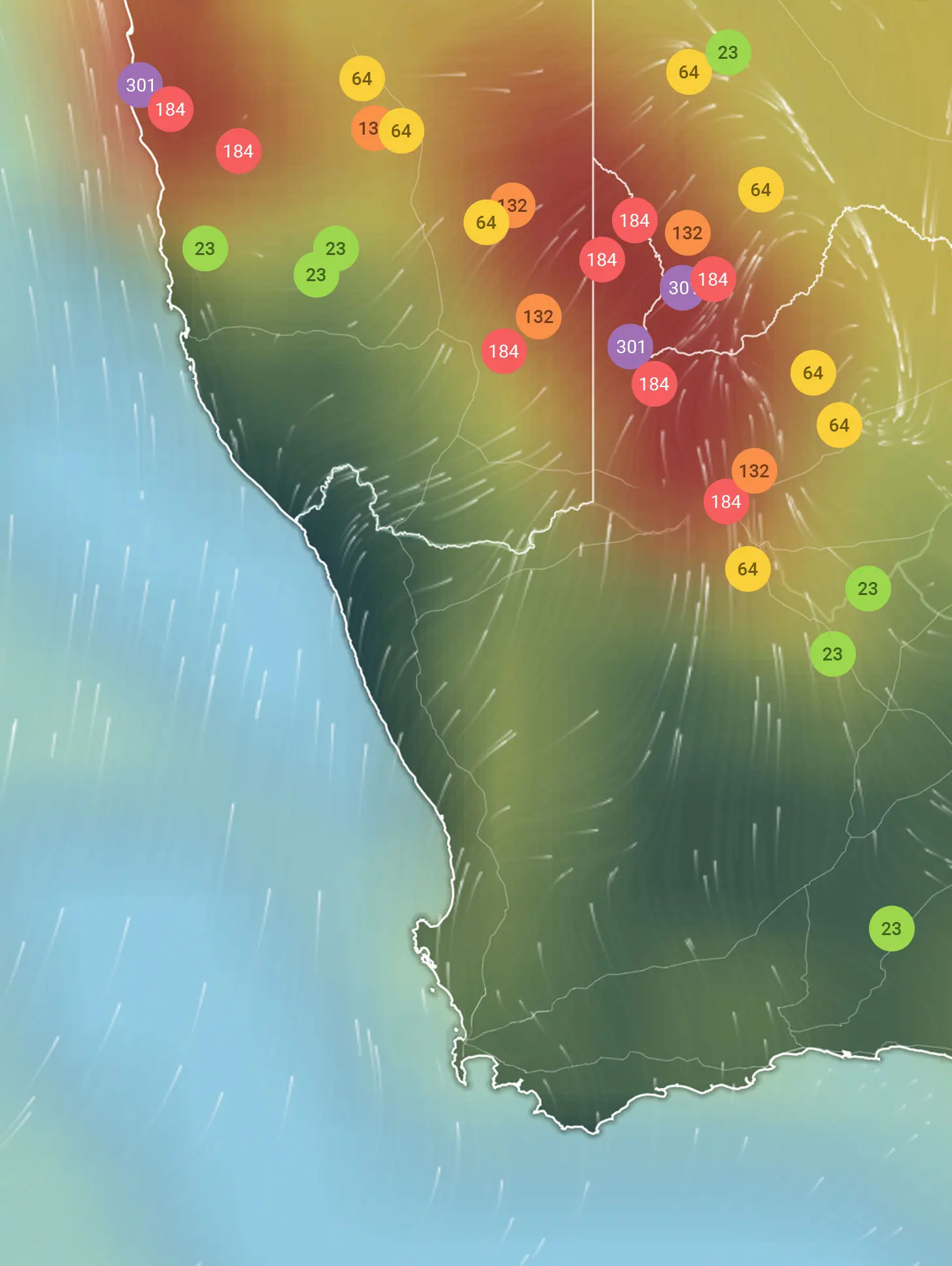
Use the air pollution map of San Jose to reveal real-time pollution concentrations and wind directions, and better understand the source of unhealthy air.
Is today a Spare the Air day in San Jose?
Spare the Air alerts are air quality advisories issued by the Bay Area Air Quality Management District (BAAQMD) indicating that current or forecast air pollution levels are unhealthy. During a San Jose Spare the Air alert, residents are recommended to both protect their health by reducing outdoor activity and protect their outdoor environment by reducing personal emissions.7
Spare the Air alerts correlate with the US air quality index (AQI) system and are usually dictated by high levels of PM2.5 or ozone pollution. When the San Jose AQI exceeds 100, “unhealthy for sensitive groups,” an alert is published. This correlates with either a PM2.5 concentration over 35.4 μg/m3 or an ozone concentration over 70 ppb.
In San Jose, Spare the Air alerts for PM2.5 pollution typically occur in the winter or during wildfire season. In 2019, for example, November was the most polluted month in San Jose as a result of the Kincade Fire that burned in Sonoma County, which caused a Spare the Air alert to be issued as AQI levels reached 150 and higher, “unhealthy.”8 2020 saw the highest frequency of Spare the Air alerts in the Bay Area as a result of a record-breaking wildfire season, which caused 51 alerts by October alone.9
Spare the Air alerts for ozone pollution, on the other hand, occur more often in the summer when temperatures are hottest. This is because ozone is a pollutant created in the atmosphere when precursor pollutants react in sunlight and temperatures warmer than 84 degrees. The hotter the temperatures, the faster ozone is likely to form. Santa Clara County, of which San Jose is a part, experiences an average of 2.8 unhealthy ozone days per year.
Pollution levels forecasted to be “orange,” “red,” “purple,” or “maroon” indicate a Spare the Air alert. Use San Jose’s forecast air quality data at the top of this page to understand when Spare the Air alerts are likely to go into place. During such events, follow the recommended health precautions and avoid driving, woodburning, and barbecuing to help reduce your personal impact on the air.
Where is smoke in San Jose coming from?
Smoky air has become part of the new normal in the Bay Area, especially during the peak wildfire season that spans July through November. Within a recent five-year period (2015-2020), there have been 3 record-breaking wildfire seasons: 2017, 2018 and 2020. Several of California's largest wildfires in history have burned close to the Bay Area in recent years, including the largest fire in California history called the August Complex Fire (2020) and the third-largest called the SCU Lightning Complex Fire (2020).
Scientists attribute the increase in wildfire activity in California and abroad to human-contributed climate change. As temperatures rise, more water is lost to evaporation, contributing to drier conditions. In recent years, wildfires near San Jose have ignited in wilderness areas all around the Bay Area. These fires are a threat not only to the environment but also to public health.
Smoke consists of deadly PM2.5, carbon monoxide, nitrogen dioxide, formaldehyde, and acetaldehyde. Breathing this combination of pollutants has been linked to hospital visits as a result of respiratory irritation and difficulty breathing as well as to more serious effects like reduced lung function, inflammation, bronchitis, heart failure, and even early death.
The IQAir air quality map of San Jose locates fires using NASA's Fire Information for Resource Management System (FIRMS) satellite observations. Understand where fires are burning, the direction of wind, and the density of nearby smoke. In recent years, fires in Mendocino, Humboldt, Glenn, Sonoma, Napa and Fresno have all caused significant spikes in air quality.
+ Article Resources
[1] Bay Area air pollution summary – 2018. (2018).
[2] State of the Air – 2020. (2020).
[3] Most populated cities in the U.S. - median household income 2018. (2019).
[4] Rogers P. (2020, March 23). Coronavirus: Bay Area air quality is improving as people stay home.
[5] Medina M. (2019, June 17). New study shows spike in Bay Area electric car sale.
[6] Hase G. (2019, October 22). City of San Jose plans to double electric car charging stations with $14 million investment.
[7] Spare the Air. (2020). What is Spare the Air? Bay Area Air Quality Management District.
[8] Rogers P. (2019, October 24). Smoke from Kincade Fire could blanket Bay Area. Bay Area News Group.
[9] Kirkwood K. (2020, October 10). Bay Area sees record number of Spare the Air alerts in 2020. KTVU.
Where is the cleanest air quality in San Jose?
- Almaden Valley station3
- Redwood Pavilion3
- Rancho Verde6
- Wooded Lake Drive11
- Dry Creek16
- Hillcrest Drive16
- America Center Drive17
- Begonia Drive 217
- Bose Lane17
- Galleria Drive17
- Iris Gardens Court17
- S 18th St at Brookwood Ave17
- San Jose17
- Santa Fe Drive17
- Briana Court18
- Potrero Drive18
- Wine Valley Villages18
- Ambum Avenue19
- Cloverdale Lane19
- Johnston Avenue20
- Marseilles Court20
- Stephen Way20
- Timberview Court20
- Anderson East22
- Blewett-Willow22
- Curtner and Lincoln22
- Meadowlark Ave22
- Northgrove Lane22
- Schiele Avenue22
- University Ave22
- 3649 Tankerland Ct23
- Beckham Drive23
- Bob White Place23
- Adeline Place24
- Almaden Hills Estates24
- Rose Garden Outside24
- Willow Glen 224
- 5219 Halifax Drive26
- Cowper Court26
- Strawberry Lane26
- 6626-6600 Canterbury Ct27
- Almaden Valley27
- Brooktree Way27
- Evergreen27
- Scarsdale Place27
- Walden Square27
- 4398-4326 Vanderbilt Dr28
- 4556 Norwich Way28
- Almaden28
- Almaden Winery Park28
- Bing Drive28
- Coastland28
- Knights Bridge Road28
- McKean Road28
- Mireille Drive28
- San Jose - Knox Ave28
- Sandra Drive28
- The Willows28
- 2198-2110 Violet Way29
- 956 Willow Glen Way back yard29
- Central San Jose29
- Crossgates neighborhood29
- Hillsdale and Cherry29
- SchnauzerLogic Studios29
- Tifton Way29
- 5815 Newgate Ct30
- Crossgates Lane30
- 3798-3712 Kenton Ln31
- 735-713 Villa Centre Way31
- Almaden Redmond Ave, 9512031
- Almaden Village Lane31
- Glenwood Avenue31
- Vermont - McKendrie31
- Walnut Grove Avenue31
- Willow Glen West31
- 342 N 20TH ST32
- 5251-5399 Meridian Avenue32
- 6199 Cahalan Ave32
- Ashland Way32
- Baird House32
- Camden Near Butcher Park32
- Corumba Court32
- Katherine Court32
- Olinder Elementary32
- Quail Creek Circle32
- Redmond Avenue32
- Baypointe Parkway 233
- Brookwood Terrace33
- San Tomas Park33
- Willow Glen33
- Berryessa34
- La Colina34
- Minnesota and Curtiss34
- Ramblewood Park34
- San Jose - Jackson Street34
- 1405 Stockbridge Drive35
- 1907 Kirkland Ave35
- Ben Lomond Way35
- Sakamoto Elementary35
- ShadowBrook Swim Club35
- 1565 Martin Avenue36
- 6039 Allen Avenue36
- Almaden Country Day School Garden36
- Cedar Gables36
- College Dr36
- Cory36
- Hampton Drive36
- Hanalei Place36
- IBM Research - Almaden36
- Ranwick Court36
- 6475 Deer Hollow Drive37
- Brookwood Avenue37
- Colleen Drive37
- Crestwood Drive37
- De Rome Drive37
- Lincoln Glen37
- Newhall Neighborhood37
- Willamette Drive37
- 301-499 Avenida Abetos38
- 405 Terrace Drive38
- Forester Court38
- Hartford Avenue38
- Montego Court38
- Rosecrest Terrace38
- 5819 Zileman Drive39
- Boynton Ave39
- Cheltenham Way39
- Martin Ave39
- Michon Drive39
- North 9th and Saint John39
- North Henry Avenue39
- Pinehurst Cabana Club39
- Purple Venado39
- Rancho Santa Teresa39
- Warner Drive39
- Willow Glen-Nord-ln39
- Woodland Avenue 139
- Creekside Park41
- East Hamilton Avenue42
- Mahuron Circle42
- Springpark Circle42
- 2360 Cherrystone Drive43
- 450 South 16th Street43
- 788 North 14th Street43
- Applewood Drive43
- Ellen Avenue43
- South Genevieve Lane43
- Thistle Dr43
- US Marine Corps Reserve Center Outside43
- 443 Shepherd Ave44
- Banta Court44
- Collomia Court44
- Pershing Avenue46
- Plympton Court47
- S18thStSanJose52
- War Admiral Avenue53