Ajouter
Qualité de l’air à Brisbane
Indice de qualité de l’air (IQA⁺) et pollution de l’air (PM2.5) à Brisbane • 285.8K Abonnés • 07:00, oct. 24 Heure locale
7
IQA⁺ USBon

Polluant principal:
PM2.5
1.3 µg/m³

22°

4 km/h

82 %
Prévisions horaires
Prévision de l’indice de qualité de l’air (IQA⁺) à Brisbane


Prévisions quotidiennes
Prévision de l’indice de qualité de l’air (IQA⁺) à Brisbane
| Aujourd’hui | 7 |  | 24° 18° |  20 km/h | 79% |
| dim. | 8 |  | 24° 19° | 21 km/h | 84% |
| lun. | 20 | | 24° 19° | 20 km/h | 88% |
Polluants atmosphériques
Quelle est la qualité de l’air actuellement à Brisbane?

La concentration de PM2,5 respecte actuellement la valeur seuil annuelle de l'OMS pour les particules PM2,5.
Recommandations de santé
 Enjoy outdoor activities |
 Open your windows to bring clean, fresh air indoors Get a monitor |
Protégez-vous de la pollution de l’air à Brisbane

Surveillez l'air que vous respirez
Obtenez des relevés précis de la qualité de l'air AirVisual et des informations en temps réel pour un air plus pur. Les moniteurs révèlent les sources de pollution et indiquent quand il est nécessaire d'utiliser un purificateur d'air.

Purificateurs d'air de qualité médicale
Reconnue dans le monde entier, la série HealthPro Series utilise la technologie HyperHEPA. Elle filtre les particules ultrafines que les autres purificateurs d'air ne parviennent pas à détecter, offrant ainsi une protection de qualité médicale.

Des purificateurs d'air puissants et élégants
Compacte et puissante, la série Atem associe l'ingénierie suisse à une purification de l'air haute performance, filtrant les particules ultrafines grâce à la technologie HyperHEPA.
Pollen
Quelle est la densité de pollen à Brisbane aujourd'hui ?
Indice

Aucun
 Arbre Aucun | 0% |
 Graminées Aucun | 0% |
 Mauvaise herbe Aucun | 0% |
Source:
wetter.comRecommandations de santé
Enjoy outdoor activities |
Open your windows to bring clean, fresh air indoors Get a monitor |
Pollen
Quelle est la densité de pollen à Brisbane aujourd'hui ?
Indice
Aucun
Arbre Aucun | 0% |
Graminées Aucun | 0% |
Mauvaise herbe Aucun | 0% |
Source:
wetter.comProtégez-vous de la pollution de l’air à Brisbane
Surveillez l'air que vous respirez
Obtenez des relevés précis de la qualité de l'air AirVisual et des informations en temps réel pour un air plus pur. Les moniteurs révèlent les sources de pollution et indiquent quand il est nécessaire d'utiliser un purificateur d'air.
Purificateurs d'air de qualité médicale
Reconnue dans le monde entier, la série HealthPro Series utilise la technologie HyperHEPA. Elle filtre les particules ultrafines que les autres purificateurs d'air ne parviennent pas à détecter, offrant ainsi une protection de qualité médicale.
Des purificateurs d'air puissants et élégants
Compacte et puissante, la série Atem associe l'ingénierie suisse à une purification de l'air haute performance, filtrant les particules ultrafines grâce à la technologie HyperHEPA.
Endroits les plus pollués près de Brisbane
Classement IQA⁺ mondial
Classement des stations
Classement IQA⁺ des stations en direct pour les stations à Brisbane

Classement des villes
Classement IQA⁺ en temps réel de la ville : Australia
Historique de la qualité de l’air près de Brisbane
Historique
Graphique de l’historique de la qualité de l’air à Brisbane
Historique de la qualité de l’air près de Brisbane
Historique
Graphique de l’historique de la qualité de l’air à Brisbane
Endroits les plus pollués près de Brisbane
Classement IQA⁺ mondialClassement des stations
Classement IQA⁺ des stations en direct pour les stations à Brisbane
Classement des villes
Classement IQA⁺ en temps réel de la ville : Australia
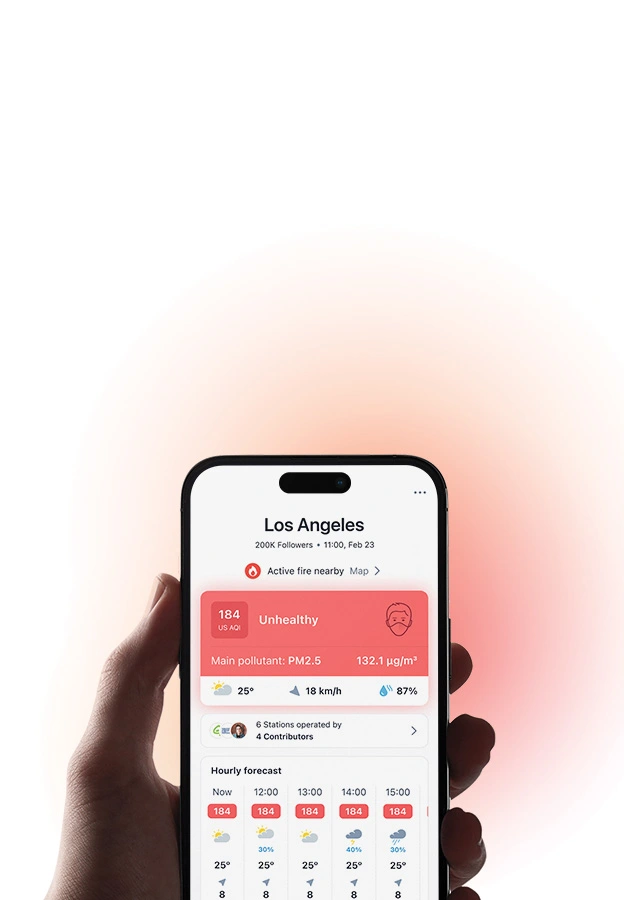


Measure your own air quality
Get a monitor and contribute air quality data in your city.
En savoir plus sur la qualité de l’air mondiale


En savoir plus sur la pollution de l'air à Brisbane
Quelle est la qualité de l'air actuelle à Brisbane ?
La qualité de l'air actuelle à Brisbane est considérée comme bonne. L'air est pur et présente peu ou pas de risque pour la santé.
How bad is the air quality in Brisbane?
The capital of Queensland state on Australia’s east coast, and the country’s 3rd most populated city, Brisbane generally experiences relatively healthy air quality year-round, in comparison with other global major cities. However, similarly to many locations in Australia, Brisbane air quality is also prone to experience short-term extreme pollution events which frequently exceed the national limits for daily air pollution exposure, such as dust storms or bushfires.1 Both these short-term extreme pollution events, and the low levels of background air pollution that are present in the air year-round, present significant health hazards to Brisbane’s 2.5 million residents.
The main pollutants of concern in Brisbane are particulate pollution (PM), nitrogen dioxide (NO2), and ozone (O3).1 Particle pollution, or particulate matter, is made up of tiny airborne particles of either 2.5 microns or 10 microns in diameter (abbreviated to PM2.5 or PM10 respectively). PM is known to be especially hazardous to human health, because its microscopic size enables the particles to penetrate deep into the human system, and even the bloodstream; while the chemical composition of PM can vary, often it contains toxic elements that can cause a range of health effects.
Live Brisbane air quality information can be viewed at the top of this page within the dynamic air quality map, which features real-time wildfire information alongside Brisbane air pollution updates and a 7-day air quality forecast.
How does Brisbane air quality compare to other cities?
In 2019, Brisbane air quality ranked as Australia’s 35th most polluted city out of 95 measured cities, according to IQAir’s 2019 World Air Quality Report.2 Its annual average PM2.5 concentration in 2019 was 8.1 μg/m3, just exceeding Australia’s national annual target of 8 μg/m3, although this still achieves the World Health Organisation (WHO)’s recommended annual guideline for PM2.5, of 10 μg/m3. 2019’s measurement shows a slight increase from previous years’ PM2.5 levels, which averaged 7.2 μg/m3 in 2018, and 6.4 μg/m3 in 2017.2 The slight increase during 2019 could partly be attributed to the particularly severe bushfires that swept Australia during the summer of 2019-2020, which affected Brisbane along with several other areas, particularly Queensland’s neighbouring state of New South Wales.3
Brisbane’s 2019 average PM2.5 level ranked the city as cleaner than other Australian major cities Canberra (15 μg/m3), Sydney (10.1 μg/m3), but more polluted than Melbourne (6.5 μg/m3).
What are the main sources of pollution in Brisbane?
The majority of air pollutants in Brisbane are generated from motor vehicles, bushfires and the burning of vegetation, domestic heating (e.g. using wood heaters in homes), paint fumes and emissions from industry.4 Of these sources, emissions from motor vehicles are particularly significant, estimated to contribute over 70% of the city’s overall air pollution. With predicted population growth within Brisbane in future, vehicle kilometres travelled are estimated to increase 30% by 2026, therefore mitigating air pollution emissions from vehicles is a high priority for Brisbane air pollution management.
Brisbane’s particulate matter emissions are commonly generated by wildfires, in addition to other sources such as road transport and industry; while nitrogen dioxide is often generated from road vehicles and industry. Brisbane’s unique geography also makes the city particularly vulnerable to ozone generation, if air quality sources are poorly managed. The capital of Queensland state, the coastal city of Brisbane sits between the Gold Coast to the north and Sunshine coast to the south, while inland it is hemmed in by the Great Dividing Range of mountains. These mountains and islands surrounding the city from the coast create a basin, in which ozone can easily form and linger.1
Is Brisbane affected by wildfires?
Australia has long experienced wildfires during its summer months, with an established fire season. Bushfires can be started naturally, by a lightning strike, or through human intervention, either through planned burning measures, an accidental human-made spark, or through malicious arson.5 However, there are some signs of Australia’s wildfires worsening over time, in line with global increasing temperatures due to climate change. Australia’s bushfires were particularly destructive during the summer of 2019-2020, due to a prolonged summer of record-breaking temperatures and prolonged drought, which had a severe knock-on impact onAustralia air quality.5 While these bushfires worst affected the state of New South Wales, followed by Victoria, there were also more limited fires burning causinghaze in Queensland and around Brisbane.6 Furthermore, the smoke generated from Queensland’s own domestic fires was intensified due to smoke from neighbouringNew South Wales air pollution, which was drawn in to mingle with Brisbane smoke by wind currents.7 On 11 November 2019 in the thick of some of these wildfires, several stations around the South East Queensland area surrounding Brisbane had 24-hour average PM2.5 concentrations ranging between 80.9 μg/m3 up to 126.7 μg/m3, with the worst readings reported from Woolloongabba (126.7 μg/m3), Southport (124.1 μg/m3), and South Brisbane (113.1 μg/m3).7 For reference, this exceeds both the WHO’s and the Australian national standard for 24-hour PM2.5 exposure, which is a matching limit of 25 μg/m3, by 3 to 5 times over.8
What is Brisbane doing about air pollution?
Brisbane City Council runs a network of seven air quality monitoring stations around the city, located in the Central Business District (CBD), Cannon Hill, Lytton, Rocklea, South Brisbane, Woolloongabba, Wynnum and Wynnum West.9 These sensors monitor a range of 6 main criteria pollutants that pose hazards to human health: carbon monoxide (CO), NO2, particulate matter (PM2.5 and PM10), sulphur dioxide (SO2), ozone, and volatile organic compounds (VOCs).
Brisbane City Council then communicates these readings to the public using a Clean Brisbane Air Quality Index. The Brisbane AQI follows the Queensland Air Quality Index system, which adopts the nationwide logic of calculating AQI numbers as a percentage of the national standard for different pollutants. Australia’s standards are known as the National Environment Protection Measure for Ambient Air Quality (NEPM). Under this system, an AQI level of “100” represents 100% of the maximum permitted amount of the specified pollutant; and numbers above 100 represent an exceedance of the national standard. The highest measurement of any given pollutant measured at a given location, will determine that location’s overall AQI number. The Queensland AQI’s color-coded scale begins with ratings of 0-33, indicating ‘Very good’ air quality, up to >150, indicating ‘Very Poor’ air quality.10 The Brisbane air quality index therefore aims to communicate air pollution numbers in an easy-to-understand single measure of health hazard, that enables the public to react quickly and take measures to protect health when necessary.
+ Article resources
[1] Brisbane City Council. “Why air quality is important”. Brisbane City Council website, April 22, 2020.
[2] IQAir. “2019 World Air Quality Report”. IQAir website, March 18, 2020.
[3] Justine Calma. “What you need to know about the Australia bushfires”. The Verge, Feburary 13, 2020.
[4] Brisbane City Council. “How you can contribute to clean air”. Brisbane City Council website, April 30, 2020.
[5] BBC. “How did Australia fires start and what is being done? A very simple guide.” BBC website, January 7, 2020.
[6] Nadja Popovich, Denise Lu and Blacki Migliozzi. “Here’s Where Australia’s Destructive Wildfires Are Burning”. New York Times, January 13, 2020.
[7] Leonie Mellor, Rebeka Powell. “Queensland fire emergency leaves Brisbane’s air quality worse than Beijing”. ABC News Australia, November 12, 2019.
[8] Australian Government. “National air quality standards: Ambient air quality (2016). Australian Government website, 2016.
[9] Brisbane City Council. “Real-time air quality index”.Brisbane City Council website, September 10, 2020.
[10] Queensland Government. “Air quality index”. Queensland Government website, August 12, 2020.